Planning a trip to Canada is exciting, whether you’re visiting family, attending a business meeting, exploring popular tourist destinations, or spending your vacation in one of the world’s most welcoming countries. However, before booking your flight, one important question needs an answer:
How long does a Canada visitor visa take to process?
The answer isn’t always straightforward.
Canada visitor visa processing times vary throughout the year. While some applications receive a decision within a few weeks, others may take several months depending on factors such as your country of residence, application volume, document completeness, security screening, and whether additional information is required.
Understanding the process before you apply helps you set realistic expectations and avoid unnecessary delays.
In this guide, you’ll learn everything you need to know about Canada visitor visa processing times, including what affects your application timeline, how to track your application, and practical steps you can take to improve your chances of a smooth and timely decision.
What Is a Canada Visitor Visa?
A Canada Visitor Visa, officially known as a Temporary Resident Visa (TRV), allows eligible foreign nationals to travel to Canada temporarily.
People commonly apply for this visa to:
- Visit family or friends
- Go on vacation
- Attend business meetings
- Participate in conferences
- Attend weddings or family events
- Receive short-term medical treatment
Depending on your nationality, you may need either a Temporary Resident Visa or an Electronic Travel Authorization (eTA). Citizens of visa-required countries must obtain a visitor visa before travelling.
It is important to understand that receiving a visitor visa does not guarantee entry into Canada. When you arrive, a border services officer will review your documents and determine whether you meet Canada’s entry requirements.
What Is the Current Canada Visitor Visa Processing Time?
Canada does not have one fixed processing time for every applicant.
Instead, processing estimates differ based on several factors, including:
- Your country of residence
- The office processing your application
- Seasonal demand
- Application complexity
- Security and background checks
Because processing times change regularly, the estimate published today may be different next month.
For that reason, applicants should always check the latest estimates on the official IRCC website before making travel plans.
More importantly, remember that published processing times are estimates, not guarantees. Some applications move much faster, while others require additional review.
How Does IRCC Calculate Processing Times?
Many applicants assume processing begins the moment they submit their application.
In reality, Immigration, Refugees and Citizenship Canada (IRCC) measures processing time based on recently completed applications.
The estimate generally includes the time needed for:
- Receiving the application
- Reviewing supporting documents
- Verifying eligibility
- Collecting biometrics (if required)
- Conducting background checks
- Completing security screening
- Making a final decision
However, the estimate may not include delays caused by missing documents, requests for additional information, or time taken by applicants to respond.
What Factors Affect Canada Visitor Visa Processing Time?
No two applications are exactly alike. Even two applicants applying on the same day may receive decisions weeks apart.
Several factors influence processing speed.
1. Country of Residence
One of the biggest factors is where you submit your application.
Applications are processed by different visa offices around the world. Some offices receive significantly higher volumes than others, which can affect waiting times.
For example, during busy travel seasons, visa offices serving countries with large numbers of applicants may experience longer queues.
2. Time of the Year
Application volumes fluctuate throughout the year.
Processing may slow during:
- Summer travel season
- Holiday periods
- Back-to-school months
- Peak tourism seasons
Applying well before your intended travel date gives you more flexibility if unexpected delays occur.
3. Completeness of Your Application
One of the easiest ways to avoid delays is by submitting a complete application.
IRCC may request additional information if documents are missing or unclear.
Common issues include:
- Missing bank statements
- Incomplete application forms
- Unclear passport scans
- Missing invitation letters
- Incorrect travel history
- Missing employment documents
Every request for additional information adds extra time to your application.
4. Biometrics Requirement
Most visitor visa applicants must provide biometrics.
Biometrics include:
- Fingerprints
- Digital photograph
Processing usually continues only after your biometrics have been successfully collected and uploaded to IRCC.
Scheduling delays at the Visa Application Centre (VAC) can therefore affect your overall timeline.
5. Background Verification
IRCC verifies the information you provide.
Depending on your circumstances, officers may review:
- Employment history
- Previous travel history
- Immigration records
- Identity documents
- Financial information
Straightforward cases often move faster than applications requiring additional verification.
6. Security Screening
Every visitor visa application goes through security screening.
For many applicants, this stage is completed quickly.
However, some applications require more extensive checks.
Security screening timelines vary considerably and are generally outside the applicant’s control.
7. Medical Examination
Most visitor visa applicants do not need a medical examination.
However, one may be required if:
- You plan to stay for an extended period in specific situations.
- You have recently lived in a country where certain public health requirements apply.
- You intend to work in occupations that require medical clearance.
If IRCC requests a medical exam, processing will continue after the results have been reviewed.
Step-by-Step Canada Visitor Visa Processing Timeline
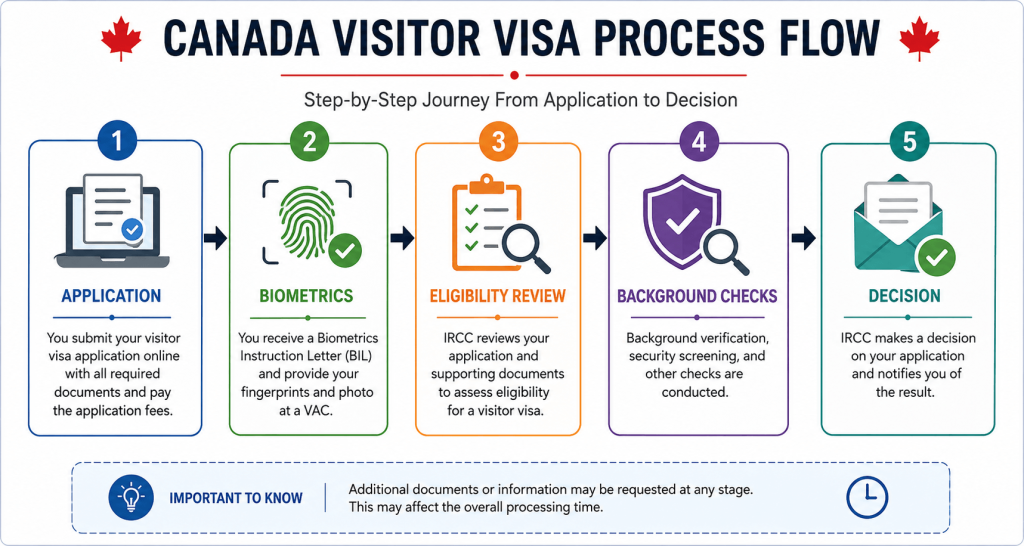
Understanding the journey from application submission to a final decision can help reduce anxiety while you wait.
A typical application follows these stages:
Step 1: Submit Your Application
You complete the required forms, upload supporting documents, and pay the application fee.
Once submitted, IRCC acknowledges receipt of your application.
Step 2: Receive the Biometrics Instruction Letter
If biometrics are required, IRCC sends you a Biometrics Instruction Letter (BIL).
This letter allows you to book an appointment at an approved Visa Application Centre.
Step 3: Provide Biometrics
You visit the Visa Application Centre on your scheduled date.
During the appointment, staff collect:
- Fingerprints
- Digital photograph
The appointment itself usually takes only a few minutes.
Step 4: Eligibility Review
An immigration officer reviews your application to determine whether you meet the visitor visa requirements.
The officer considers factors such as:
- Purpose of travel
- Financial ability
- Home country ties
- Previous travel history
- Supporting documents
Strong, well-organized applications generally move through this stage more smoothly.
Step 5: Background and Security Checks
After the eligibility review, IRCC completes any necessary background and security checks.
The length of this stage varies from one applicant to another and depends on individual circumstances.
Step 6: Final Decision
Once all required checks are complete, IRCC makes a decision.
If approved, you’ll receive instructions for the next steps, which may include submitting your passport if a visa counterfoil needs to be issued.
If refused, IRCC will provide a refusal letter explaining the reasons for the decision.
Canada Visitor Visa Processing Time After Biometrics
Many applicants believe that once they have completed their biometrics appointment, their visa will be approved within a few days. In reality, biometrics are only one step in the application process.
After your fingerprints and photograph are collected at a Visa Application Centre (VAC), they are securely transmitted to Immigration, Refugees and Citizenship Canada (IRCC). Your application then moves to the next stage of assessment.
During this period, an immigration officer may:
- Review your supporting documents.
- Assess whether you meet the visitor visa requirements.
- Conduct background and security checks.
- Verify your travel history.
- Request additional documents if necessary.
Some applicants receive a decision shortly after biometrics, while others may wait much longer. The timeline depends on your individual application and the workload at the visa office handling your case.
For this reason, avoid comparing your application with someone else’s. Two applicants who completed biometrics on the same day may receive decisions weeks apart.
Canada Visitor Visa Processing Time from Nigeria
Nigeria remains one of the largest sources of visitor visa applications to Canada.
Processing times for Nigerian applicants can fluctuate throughout the year depending on:
- Seasonal demand
- Number of applications received
- Staffing levels
- Security checks
- Individual circumstances
Applicants from Nigeria should submit their applications well in advance of their intended travel date rather than waiting until the last minute.
To improve your chances of faster processing, ensure you provide:
- A valid passport
- Proof of sufficient funds
- A clear travel itinerary
- Strong ties to Nigeria
- Employment or business documents
- Accurate travel history
Providing complete and well-organized documentation reduces the likelihood of additional document requests that can delay processing.
Canada Visitor Visa Processing Time from India
India is another major source of visitor visa applications.
Processing times may vary depending on:
- The visa office handling the application
- Application volume
- Completeness of documentation
- Whether additional verification is required
Applicants should regularly check their IRCC account for updates rather than relying solely on estimated timelines shared online.
Canada Visitor Visa Processing Time from Ghana
Applicants from Ghana follow the same general application process.
However, timelines may differ because applications are processed according to local workloads and available resources.
Submitting a complete application with clear supporting evidence helps avoid unnecessary delays.
Canada Visitor Visa Processing Time from Pakistan
Canadian visitor visa applications from Pakistan may require additional processing depending on the applicant’s circumstances.
Applicants should carefully review the document checklist before submission and respond promptly if IRCC requests further information.
Why Is My Canada Visitor Visa Taking So Long?
Waiting longer than expected can be frustrating, especially if you have already booked accommodation or planned your trip.
Several reasons may explain why your application is taking longer than the estimated processing time.
1. High Application Volumes
Canada experiences periods of exceptionally high demand, particularly before:
- Summer holidays
- Christmas
- Major international events
- University intake seasons
During these periods, visa offices process significantly more applications than usual.
2. Background Verification
IRCC may need additional time to verify:
- Employment history
- Previous travel
- Identity documents
- Financial information
These checks help protect Canada’s immigration system and ensure applications meet legal requirements.
3. Security Screening
Security screening timelines differ for every applicant.
This stage is confidential, and IRCC does not usually provide detailed updates while it is in progress.
4. Missing Documents
One of the most common reasons for delays is an incomplete application.
Examples include:
- Missing bank statements
- Unclear passport copies
- Missing invitation letters
- Incomplete travel itinerary
- Missing employment documents
Whenever IRCC requests additional information, processing pauses until the required documents are received and reviewed.
5. Medical Examination Requests
Although most visitor visa applicants do not require a medical examination, those who do may experience longer processing times while results are reviewed.
How to Avoid Canada Visitor Visa Processing Delays
Although you cannot control every aspect of the process, you can significantly reduce avoidable delays.
Apply Early
Never wait until a few weeks before your planned trip.
Submitting your application several months in advance gives you enough time to deal with unexpected requests.
Double-Check Your Documents
Review every document before submission.
Ensure:
- Names match your passport.
- Dates are accurate.
- Financial documents are up to date.
- Passport copies are clear.
- Supporting letters are signed where necessary.
Be Honest
Never provide false information.
Misrepresentation can result in:
- Visa refusal
- Future inadmissibility
- Long-term immigration consequences
Always answer questions truthfully.
Respond Quickly
If IRCC contacts you requesting additional documents, respond as soon as possible.
Delays in replying can extend your overall processing time.
Monitor Your IRCC Account
Check your online account regularly for:
- New messages
- Document requests
- Status updates
- Final decisions
Missing an important notification could delay your application.
How to Check Your Canada Visitor Visa Status
After submitting your application, you can monitor its progress through your online IRCC account.
Depending on your application stage, you may see updates such as:
- Application received
- Biometrics completed
- Eligibility review in progress
- Background verification
- Final decision made
If you submitted your application through a Visa Application Centre, you may also receive updates from the VAC regarding passport transmission and collection.
Frequently Asked Questions
How long does a Canada visitor visa usually take?
There is no single processing time. IRCC publishes estimated timelines that vary by country and change regularly.
Does biometrics mean my visa is approved?
No.
Biometrics only confirm your identity. IRCC still needs to complete eligibility, background, and security assessments before making a decision.
Can I speed up my visitor visa application?
There is no general expedited service for standard visitor visa applications.
The best approach is to submit a complete, accurate application as early as possible.
Can I travel while my application is processing?
No.
You should wait until you receive a final decision and, if required, your passport with the visa before making irreversible travel arrangements.
What if my processing time exceeds the estimate?
Processing estimates are not guarantees.
If your application has exceeded the published timeline, continue monitoring your IRCC account and follow official guidance before making inquiries.
Will previous travel history help?
A positive travel history may strengthen your application, but it does not guarantee faster processing or approval.
Each application is assessed on its own merits.
Can missing documents delay my application?
Yes.
Incomplete applications are among the most common reasons for longer processing times.
Does applying online process faster?
Online applications are generally easier to manage and track, but processing times depend on the individual application rather than the submission method alone.
Final Thoughts
Applying for a Canada visitor visa requires careful preparation, realistic expectations, and patience. While everyone hopes for a quick decision, processing times can vary depending on application volumes, document quality, security checks, and the applicant’s individual circumstances.
The best way to improve your experience is to submit a complete and accurate application, provide all required supporting documents, and monitor your IRCC account for updates. Applying early also gives you more flexibility if additional information is requested.
Finally, remember that the processing time shown by IRCC is an estimate rather than a promise. Some applications move quickly, while others require additional review. Instead of comparing your timeline with someone else’s, focus on ensuring your own application is as strong and complete as possible.
By staying informed and following official guidance, you’ll be better prepared for every stage of the Canada visitor visa process and increase your chances of a smooth journey from application to decision.