The United Kingdom has long been one of the world’s leading destinations for international education. Every year, hundreds of thousands of students travel to England, Scotland, Wales, and Northern Ireland to study at internationally respected universities and colleges.
Whether you’re planning to pursue an undergraduate degree, a master’s programme, a PhD, or another eligible course, you’ll usually need permission to study in the UK.
One of the first questions applicants ask is:
How long does a UK Student Visa take to process?
The answer depends on several factors.
Although UK Visas and Immigration (UKVI) publishes standard processing targets, the actual time required can vary depending on your country of application, the time of year, application volume, document completeness, and whether additional checks are required.
Understanding the application process before you submit your documents can help you prepare a stronger application and reduce the risk of unnecessary delays.
This guide explains everything you need to know about UK Student Visa processing times, including application stages, biometrics, common delays, passport collection, and practical tips for international students.
What Is a UK Student Visa?
A UK Student Visa allows eligible international students to study at an approved educational institution in the United Kingdom.
To qualify, applicants generally need:
- An unconditional offer from a licensed student sponsor.
- A valid Confirmation of Acceptance for Studies (CAS).
- Evidence that they can financially support themselves.
- Proof of English language ability where required.
- A genuine intention to study.
Unlike a visitor visa, a Student Visa allows eligible students to remain in the UK for the duration of their course and, in many cases, work within the conditions attached to their visa.
Current UK Student Visa Processing Time
Most UK Student Visa applications are processed within the standard service published by UKVI.
However, processing times may vary depending on:
- Country of application
- Time of year
- Number of applications being processed
- Supporting documents submitted
- Additional verification
- Security checks
Applicants planning to begin studies in September should apply as early as possible because this is the busiest student visa period of the year.
How UK Student Visa Processing Works
Submitting your online application is only the beginning of the process.
After your application has been received, UKVI continues through several assessment stages before making a final decision.
These typically include:
- Online application submission
- Biometrics appointment
- Supporting document review
- CAS verification
- Financial assessment
- Eligibility review
- Background checks
- Decision
- Passport return
Each stage helps immigration officers determine whether you meet the Student Visa requirements.
Factors That Affect UK Student Visa Processing Time
Every student’s application is unique.
Several factors influence how quickly a decision is made.
Country of Application
Applications submitted from different countries may be processed by different visa decision centres.
Workload varies between locations.
Peak Student Intake
The busiest periods usually occur before:
- September intake
- January intake
- Spring intakes
During these periods, UKVI receives significantly more student visa applications.
Applying early helps reduce the risk of delays.
Completeness of Your Application
Incomplete applications frequently require additional review.
Common missing documents include:
- Confirmation of Acceptance for Studies (CAS)
- Financial evidence
- Passport
- Academic qualifications
- Tuberculosis (TB) certificate, where required
- English language evidence
Submitting complete documentation from the beginning helps avoid unnecessary delays.
Biometrics
Most applicants must attend a Visa Application Centre to provide:
- Fingerprints
- Digital photograph
Biometrics verify your identity but do not mean your visa has been approved.
Financial Assessment
One of the most important parts of the application is demonstrating that you have enough money to pay for:
- Tuition fees
- Living expenses
- Accommodation
- Other study-related costs
Weak or inconsistent financial documentation may result in delays or refusal.
Background Verification
UKVI may verify information relating to:
- Educational history
- Immigration history
- Identity
- Supporting documents
Some applications require additional verification before a decision is made.
Security Checks
Every applicant undergoes security screening before a visa can be issued.
The time required varies between applicants.
UK Student Visa Application Timeline
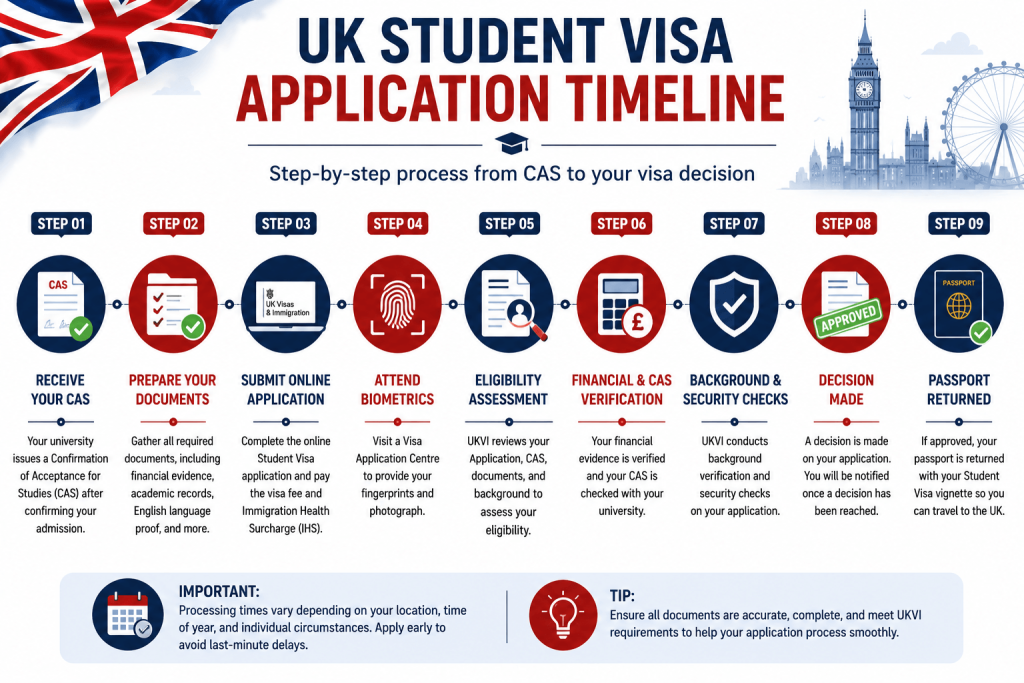
Although every application differs slightly, most follow the same general process.
Step 1: Receive Your CAS
Before applying, your university issues a Confirmation of Acceptance for Studies (CAS) after confirming your admission.
Without a valid CAS, you generally cannot apply for a Student Visa.
Step 2: Prepare Your Documents
Gather all required documents before beginning your application.
These commonly include:
- Passport
- CAS
- Financial evidence
- Academic transcripts
- English language evidence
- Tuberculosis certificate (where required)
Step 3: Submit Your Online Application
Complete the online Student Visa application and pay the required fees.
You may also need to pay the Immigration Health Surcharge (IHS), depending on your circumstances.
Step 4: Attend Biometrics
Visit your chosen Visa Application Centre to provide:
- Fingerprints
- Digital photograph
Supporting documents may also be submitted or verified during this appointment.
Step 5: Eligibility Assessment
A UKVI caseworker reviews your application.
They assess:
- Your CAS
- Financial evidence
- Educational background
- Immigration history
- Supporting documents
- Whether you meet the Student Visa requirements
Step 6: Background and Security Checks
Once eligibility has been assessed, UKVI completes background verification and security checks.
Most applicants pass through this stage without any issues.
Step 7: Final Decision
If approved, your passport is returned with your Student Visa vignette (where applicable), allowing you to travel to the United Kingdom.
If refused, UKVI provides an explanation outlining the reasons for the decision.
Confirmation of Acceptance for Studies (CAS)
The CAS is one of the most important documents in your application.
It is an electronic record issued by your university after confirming:
- Your admission
- Your course
- Tuition fees
- Sponsorship details
The CAS contains a unique reference number that UKVI uses to verify your admission.
Applicants should carefully review their CAS for accuracy before submitting their visa application.
Financial Requirements
UKVI expects applicants to demonstrate that they can financially support themselves during their studies.
Financial evidence may include:
- Personal bank statements
- Parent or guardian bank statements
- Student loans
- Official sponsorship letters
- Government scholarships
Applicants should ensure that their financial documents meet the required format and cover the necessary maintenance period before applying.
UK Student Visa Processing Time After Biometrics
Completing your biometrics appointment is a significant milestone in your UK Student Visa application. However, many students mistakenly believe that once they have provided their fingerprints and photograph, their visa is almost guaranteed.
In reality, biometrics simply confirm your identity.
After your biometric information has been collected, UK Visas and Immigration (UKVI) continues assessing your application before making a final decision.
Several important stages still remain, including:
- Eligibility assessment
- CAS verification
- Financial assessment
- Supporting document review
- Background verification
- Security checks
- Final decision
Some applicants receive a decision within a relatively short period after biometrics, while others may wait longer depending on their circumstances and the volume of applications being processed.
UK Student Visa Processing Time from India
India is one of the largest sources of international students studying in the United Kingdom.
Every year, thousands of Indian students apply to attend British universities.
Processing times for applicants from India depend on several factors, including:
- Application volume
- Time of year
- Financial verification
- Supporting documents
- Security checks
Students planning for the September intake should apply as early as possible because this is typically the busiest period for UK Student Visa applications.
Applicants should ensure they submit:
- Valid passport
- CAS
- Financial evidence
- Academic qualifications
- English language evidence
- Tuberculosis certificate, where applicable
Strong documentation helps reduce avoidable delays.
UK Student Visa Processing Time from Nigeria
The United Kingdom remains a popular destination for Nigerian students pursuing undergraduate and postgraduate education.
Applicants from Nigeria should pay particular attention to financial documentation and supporting evidence.
Strong applications usually include:
- Genuine financial evidence
- Accurate academic records
- Valid CAS
- Clear study plans
- Tuberculosis certificate where required
Submitting organized documentation makes it easier for UKVI to assess your application efficiently.
Why Is My UK Student Visa Taking So Long?
Waiting for a visa decision can be stressful, particularly when your course start date is approaching.
Fortunately, a longer processing time does not necessarily indicate that your application will be refused.
Several factors commonly contribute to delays.
High Student Application Volumes
UK universities receive the largest number of international students before:
- September intake
- January intake
- Spring intake
During these periods, visa processing centres handle significantly more applications.
CAS Verification
UKVI verifies the information contained in your Confirmation of Acceptance for Studies.
If clarification is required from your university, processing may take longer.
Financial Verification
Financial evidence is carefully reviewed.
If bank statements or sponsorship documents require additional verification, processing may be delayed.
Additional Document Requests
UKVI may request additional documentation such as:
- Updated bank statements
- New CAS
- Academic records
- Identity documents
- Financial clarification
Processing usually pauses until the requested documents have been reviewed.
Background Checks
UKVI may review:
- Immigration history
- Previous visas
- Educational records
- Identity documents
The amount of time required varies depending on the applicant.
Security Screening
Every applicant undergoes security screening before a visa decision can be made.
Applicants cannot speed up this process.
How to Avoid UK Student Visa Processing Delays
Although some delays remain outside your control, careful preparation can improve your chances of receiving a timely decision.
Apply Early
Do not wait until a few weeks before your course begins.
Submitting your application several months before your intended start date provides extra time if UKVI requests additional documents.
Double-Check Your CAS
Before applying, ensure that your CAS details are accurate.
Incorrect information can delay processing.
Prepare Strong Financial Evidence
Financial documents should clearly demonstrate that you meet UKVI’s maintenance requirements.
Avoid inconsistencies between:
- Bank statements
- Sponsorship letters
- Tuition payments
Submit Clear Supporting Documents
Ensure that every uploaded document is:
- Complete
- Legible
- Current
- Correctly translated where necessary
Poor-quality uploads may lead to additional document requests.
Respond Quickly to UKVI Requests
If UKVI contacts you requesting additional information, respond promptly.
Delays in replying can increase your overall processing time.
How to Track Your UK Student Visa Application
After submitting your application, you can monitor its progress through notifications from your Visa Application Centre and, where available, UKVI updates.
Typical milestones include:
- Application submitted
- Biometrics completed
- Application under review
- Decision made
- Passport dispatched
- Passport ready for collection
Depending on your application centre, you may also receive SMS or email updates.
Frequently Asked Questions
How long does a UK Student Visa take?
Processing times vary depending on your country of application, the time of year, application volume, and individual circumstances.
Does biometrics mean my Student Visa is approved?
No.
Biometrics only verify your identity.
UKVI must still assess your eligibility, financial evidence, CAS, supporting documents, and complete background and security checks.
Can I speed up my Student Visa application?
Some countries offer Priority and Super Priority services for eligible applicants.
Where these services are unavailable, submitting a complete application remains the best way to avoid unnecessary delays.
Why is my Student Visa taking longer than expected?
Common reasons include:
- Peak student intake
- Financial verification
- CAS verification
- Background checks
- Additional document requests
- Security screening
Can I work while studying in the UK?
Many Student Visa holders are permitted to work under specific conditions during their studies.
Always check the work conditions printed on your visa and follow UK immigration rules.
What happens if my Student Visa is refused?
UKVI will issue a refusal notice explaining why your application was unsuccessful.
Depending on your circumstances, you may be able to submit a new application after addressing the issues identified.
Do I need a CAS before applying?
Yes.
A valid Confirmation of Acceptance for Studies (CAS) is generally required before you can submit a UK Student Visa application.
Can I travel before receiving my visa?
No.
You should wait until you receive your passport with the visa before making final travel arrangements.
Can I visit the UK before my course begins?
Some students arrive shortly before their programme starts, provided they hold a valid Student Visa.
If your trip is purely for tourism or visiting family before your studies, our UK Visitor Visa Processing Time guide explains how visitor visa applications differ from student visa applications.
Can I stay in the UK after graduation?
Many graduates may qualify for further immigration routes after completing their studies, depending on the immigration rules in force at the time.
Final Thoughts
A UK Student Visa is one of the most important documents you’ll obtain before beginning your education in the United Kingdom. Although processing times vary depending on your country, application volume, and the complexity of your case, submitting a complete and well-prepared application greatly improves your chances of a smooth experience.
Before applying, ensure that your CAS is accurate, your financial evidence meets UKVI requirements, and all supporting documents are complete and easy to understand. Small mistakes, such as missing documents or inconsistent financial information, can result in avoidable delays.
It’s also wise to apply as early as possible, particularly if you’re planning to begin your studies during the busy September intake. Early preparation gives you enough time to respond to any additional requests from UKVI without risking delays to your course start date.
Finally, remember that every application is assessed individually. Rather than comparing your timeline with those shared on forums or social media, focus on the quality of your own application and monitor official updates from UKVI.
With careful planning and accurate documentation, you’ll be well positioned to receive your Student Visa and begin your academic journey in the United Kingdom.