Canada continues to attract skilled workers, temporary foreign workers, seasonal employees, and international professionals from around the world. With a strong labour market, competitive salaries, and multiple immigration pathways, thousands of people apply for Canadian work permits every year.
However, before making travel arrangements or accepting a job offer, one important question usually comes up:
How long does a Canada work permit take to process?
The answer depends on several factors. Unlike a fixed timeline, Canada work permit processing times vary based on your country of residence, the type of work permit you are applying for, application volume, and whether Immigration, Refugees and Citizenship Canada (IRCC) requires additional information before making a decision. IRCC updates its estimated processing times regularly based on current workloads and recently completed applications.
Understanding these factors before you apply will help you plan your move more effectively and reduce unnecessary stress while waiting for a decision.
Whether you are applying under the Temporary Foreign Worker Program (TFWP), the International Mobility Program (IMP), or another work permit category, this guide explains everything you need to know about Canada work permit processing times.
Planning to visit Canada instead of working? Before applying for a work permit, you may also find our guide on Canada Visitor Visa Processing Time helpful. It explains how visitor visa timelines work, what affects processing, and what happens after biometrics. If you’re considering entering Canada as a visitor before becoming eligible for certain work permit pathways, understanding visitor visa processing can help you plan your timeline more effectively.
What Is a Canada Work Permit?
A Canada work permit is an official authorization that allows eligible foreign nationals to work legally in Canada for a specific period.
Most foreign workers need a work permit before they can begin employment. However, the type of permit you receive depends on your circumstances.
The two main categories are:
Employer-Specific Work Permit
This permit allows you to work only:
- For a specific employer
- At a specific location (where applicable)
- For the period stated on the permit
Many employer-specific work permits require a Labour Market Impact Assessment (LMIA) before the application can proceed.
Open Work Permit
An open work permit gives you greater flexibility.
Instead of being tied to one employer, it allows you to work for most eligible employers across Canada.
Open work permits are commonly issued to:
- Spouses of eligible workers
- Spouses of international students
- Some permanent residence applicants
- Certain humanitarian applicants
Because eligibility requirements differ, processing times may also vary between permit types.
What Is the Current Canada Work Permit Processing Time?
There is no single processing time that applies to every work permit application.
IRCC calculates estimated processing times based on:
- Current application inventory
- Number of officers available
- Application volumes
- Recently completed cases
- Country of residence
- Type of work permit
These estimates are updated regularly and should be treated as guides rather than guarantees. A straightforward application may be finalized more quickly, while applications requiring additional review or verification can take longer.
How Does IRCC Calculate Work Permit Processing Times?
Many applicants assume that processing starts the day they upload their application.
In practice, your processing time begins when IRCC receives a complete application.
It generally includes:
- Initial completeness check
- Document review
- Eligibility assessment
- Biometrics (where required)
- Background verification
- Security screening
- Final decision
If IRCC requests additional documents or clarification, the overall timeline may increase because processing can pause until the requested information is received.
Factors That Affect Canada Work Permit Processing Time
No two applications follow exactly the same path.
Several factors influence how quickly your application moves through the system.
1. Country of Residence
Processing times vary depending on where you apply.
Different visa offices receive different numbers of applications throughout the year, which affects workload and waiting times.
Applicants from one country may receive decisions sooner than applicants applying through another visa office, even when applying under the same program.
2. Type of Work Permit
Processing times differ between:
- Open Work Permits
- Employer-Specific Work Permits
- LMIA-Based Work Permits
- LMIA-Exempt Work Permits
- International Experience Canada (IEC)
- Post-Graduation Work Permits (where applicable)
Each category has different eligibility requirements and document reviews.
3. Labour Market Impact Assessment (LMIA)
Some jobs require a positive LMIA before a foreign worker can apply for a work permit.
The LMIA process is separate from the work permit application itself.
If your employer must first obtain an LMIA, you should account for that additional processing stage when planning your move.
4. Completeness of Your Application
One of the biggest causes of delays is an incomplete application.
Before submitting your application, check that you have included:
- A valid passport
- Job offer (if required)
- LMIA documentation (if applicable)
- Educational documents
- Employment history
- Police certificates (if requested)
- Medical examination results (when required)
- Proof of qualifications
Submitting a complete application reduces the likelihood of document requests later in the process.
5. Biometrics
Most applicants are required to provide biometrics.
This involves:
- Fingerprints
- Digital photograph
Processing generally continues after IRCC receives your biometric information from the Visa Application Centre.
6. Medical Examination
Some foreign workers must complete an immigration medical examination.
This commonly applies to applicants who:
- Will work in healthcare
- Will work with children
- Have recently lived in countries where medical screening is required
- Intend to work in occupations subject to public health requirements
If a medical examination is required, processing continues after IRCC reviews the results.
7. Background and Security Checks
Every work permit application undergoes background and security verification.
These checks help confirm:
- Identity
- Immigration history
- Employment information
- Criminal admissibility
- Security admissibility
Some applications pass through this stage quickly, while others require additional verification depending on the applicant’s individual circumstances.
Canada Work Permit Application Timeline
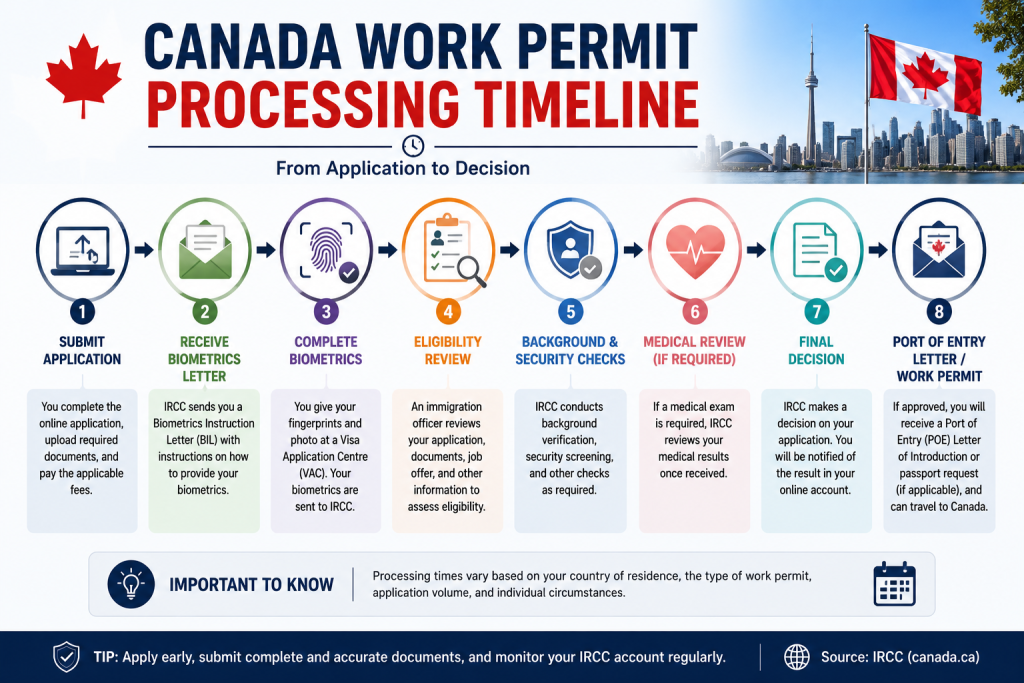
Although every application is different, most work permit applications follow a similar sequence.
Step 1: Submit Your Application
You complete the required forms, upload supporting documents, pay the applicable fees, and submit your application online or through the approved process.
Step 2: Receive Your Biometrics Instruction Letter
If biometrics are required, IRCC sends you a Biometrics Instruction Letter (BIL).
You then book an appointment at an authorized Visa Application Centre.
Step 3: Complete Biometrics
During your appointment, your fingerprints and digital photograph are collected.
This information is securely transmitted to IRCC for use during identity verification and background checks.
Step 4: Eligibility Review
An immigration officer reviews your application to determine whether you meet the requirements for the work permit category you applied under.
This includes reviewing:
- Job offer
- Employer documents
- Supporting evidence
- Qualifications
- Previous immigration history
Step 5: Background and Security Screening
Once eligibility has been assessed, IRCC completes any necessary background and security checks.
The duration of this stage varies depending on the applicant’s circumstances and cannot be predicted with certainty.
Step 6: Final Decision
After all required reviews have been completed, IRCC makes a final decision.
If your application is approved, you will receive instructions on the next steps, which may include submitting your passport if required or receiving your port of entry letter of introduction, depending on your application type.
Canada Work Permit Processing Time After Biometrics
After you complete biometrics, your application does not automatically move to approval. Biometrics simply help IRCC confirm your identity. Once the Visa Application Centre collects your fingerprints and photo, the information is sent to IRCC and attached to your application.
At this stage, an officer may continue reviewing your eligibility, employer documents, job offer, background history, and admissibility. If your application is simple and complete, the remaining process may move faster. However, if IRCC needs extra verification, the application may take longer.
This is why some applicants receive a decision shortly after biometrics, while others wait for several weeks or months.
Canada Work Permit Processing Time from Nigeria
Canada work permit processing time from Nigeria can vary based on application volume, document quality, type of work permit, and background checks.
Nigerian applicants should pay close attention to document clarity. IRCC may spend more time reviewing employment history, proof of qualifications, employer documents, and travel history if anything appears unclear.
To avoid delays, Nigerian applicants should prepare:
- A valid passport
- Job offer letter
- Employment contract
- LMIA number or LMIA-exempt offer number, if applicable
- Educational certificates
- Proof of work experience
- Police certificate, if requested
- Medical exam result, if required
- Clear evidence that they meet the job requirements
The stronger and clearer your documents are, the easier it becomes for an officer to review your application.
Canada Work Permit Processing Time from India
India is one of the largest sources of Canadian work permit applications. Because of this, processing times can change often depending on demand.
Applicants from India may apply under different categories, including employer-specific work permits, open work permits, intra-company transfers, and LMIA-exempt pathways.
A complete application is very important. If your job offer, employer documents, or qualifications are not clear, IRCC may request more information. That can extend the overall timeline.
Canada Open Work Permit Processing Time
An open work permit allows eligible applicants to work for most employers in Canada. It is different from an employer-specific work permit because it is not tied to one employer.
People who may qualify for an open work permit include:
- Spouses of eligible workers
- Spouses of eligible international students
- Some permanent residence applicants
- Certain vulnerable workers
- Some applicants under special public policies
Open work permit processing time depends on the applicant’s category and country of residence. For example, a spouse of a skilled worker may have a different timeline from someone applying under another open work permit pathway.
Canada Employer-Specific Work Permit Processing Time
An employer-specific work permit allows you to work for one named employer in Canada. It may also include details such as job location, job title, and duration of employment.
This type of application often requires stronger employer documentation. IRCC may review:
- The job offer
- Employer compliance details
- LMIA approval, if required
- Wage and job duties
- Applicant qualifications
- Work experience
Because the application depends heavily on both the employer and the worker, delays may happen if any employer document is missing or unclear.
Canada LMIA Work Permit Processing Time
An LMIA-based work permit involves two stages.
First, the Canadian employer may need to apply for a Labour Market Impact Assessment. This process is handled separately from the work permit application. If the employer receives a positive LMIA, the foreign worker can then apply for a work permit.
Because of this, applicants should not only think about the work permit processing time. They should also consider the time it takes for the employer to get the LMIA.
This makes the full journey longer than some LMIA-exempt work permit pathways.
Why Is My Canada Work Permit Taking So Long?
A work permit application may take longer than expected for several reasons.
High application volume is one common reason. When many people apply at the same time, visa offices may experience longer queues.
Another reason is document verification. IRCC may need extra time to confirm your job offer, employment history, qualifications, or identity documents.
Security and background checks can also extend the timeline. These checks are normal, but they do not follow the same timeline for everyone.
Your application may also be delayed if IRCC requests more documents. Once they request additional information, your application may not move forward until you respond.
Common Reasons for Canada Work Permit Delays
The most common reasons include:
- Missing documents
- Unclear passport scan
- Weak job offer letter
- Incomplete employment history
- Employer compliance issues
- LMIA problems
- Medical exam delays
- Biometrics appointment delays
- Security screening
- Background verification
- Slow response to IRCC requests
Many delays are avoidable. Before submitting, check your documents carefully and make sure every file is clear, complete, and accurate.
How to Avoid Canada Work Permit Processing Delays
Start by applying early. Do not wait until your expected job start date is close.
Next, submit a complete application. Make sure every document listed in your checklist is included.
Also, use clear file names when uploading documents. For example:
- Passport.pdf
- Job-Offer-Letter.pdf
- Employment-Contract.pdf
- Education-Certificate.pdf
- Proof-of-Work-Experience.pdf
This makes your application easier to review.
In addition, ensure that your job duties match your experience. If your job offer says you are being hired as a software developer, your employment history and qualifications should support that role.
Finally, check your IRCC account regularly. If IRCC sends a request and you miss it, your application may be delayed or refused.
How to Track Your Canada Work Permit Application
You can track your application through your IRCC online account.
Common updates may include:
- Application submitted
- Biometrics requested
- Biometrics completed
- Eligibility review in progress
- Background check in progress
- Medical passed
- Final decision
However, the online status does not always update in detail. Sometimes, applicants receive little movement for weeks, even though processing is still ongoing.
If your application has passed the estimated processing time, you may use the official IRCC web form to make an inquiry. However, avoid sending repeated inquiries too early because this may not speed up the process.
Canada Work Permit Approval Timeline
A typical approval journey may look like this:
Application submitted → Biometrics instruction letter → Biometrics completed → Eligibility review → Background checks → Medical review, if required → Final decision → Port of entry letter or passport request
The exact order may vary depending on your application. For example, some applicants complete medical exams before submission, while others receive a medical request later.
What Happens After Canada Work Permit Approval?
If your application is approved from outside Canada, you may receive a port of entry letter of introduction. This letter is not the actual work permit. Instead, you present it when you arrive in Canada.
A border officer will review your documents and may issue the work permit at the port of entry.
You should travel with:
- Passport
- Port of entry letter
- Job offer
- Employment contract
- LMIA or offer number, if applicable
- Proof of qualifications
- Any documents used in your application
If a visa counterfoil is required, IRCC may also request your passport before you travel.
Canada Work Permit Processing Time FAQs
How long does a Canada work permit take?
Canada work permit processing time varies by country, work permit type, application volume, and individual circumstances. Always check the latest official estimate before planning your travel.
Does biometrics mean my work permit is approved?
No. Biometrics only confirm your identity. IRCC still needs to review your eligibility, documents, background, and admissibility before making a decision.
Can I speed up my Canada work permit application?
In most cases, there is no simple way to speed it up. The best approach is to submit a complete and accurate application, respond quickly to requests, and apply early.
Why is my Canada work permit delayed?
Your application may be delayed because of missing documents, background checks, employer verification, medical review, biometrics delays, or high application volume.
Is an LMIA required for every Canada work permit?
No. Some work permits require an LMIA, while others are LMIA-exempt. The requirement depends on the job, employer, and immigration program.
What happens after my work permit is approved?
If you apply from outside Canada, you may receive a port of entry letter. You will present this letter when arriving in Canada, and the officer may issue your actual work permit.
Can I work in Canada while waiting for my work permit?
In most cases, you cannot start working until you are legally authorized. Some applicants inside Canada may have maintained status, but this depends on their situation.
Does a job offer guarantee work permit approval?
No. A job offer helps support your application, but IRCC must still confirm that you meet all requirements.
Can a Canada work permit be refused?
Yes. A work permit can be refused if the applicant does not meet eligibility requirements, submits weak documents, has admissibility issues, or fails to satisfy the officer.
Should I book my flight before work permit approval?
It is safer to wait until your application is approved before booking non-refundable travel.
Final Thoughts
Canada work permit processing time depends on many moving parts. Your country of residence, work permit category, employer documents, biometrics, medical exam, and background checks can all affect how long you wait.
Although you cannot control every part of the process, you can reduce avoidable delays by submitting a complete application, using clear documents, responding quickly to IRCC requests, and applying early.
Most importantly, do not rely on someone else’s timeline as your own. Two people may apply for similar work permits and still receive decisions at different times.
Instead, focus on what you can control: prepare strong documents, follow official instructions, monitor your IRCC account, and allow enough time before your expected work start date.
A well-prepared application gives IRCC fewer reasons to pause your file and gives you a better chance of moving smoothly from submission to decision.