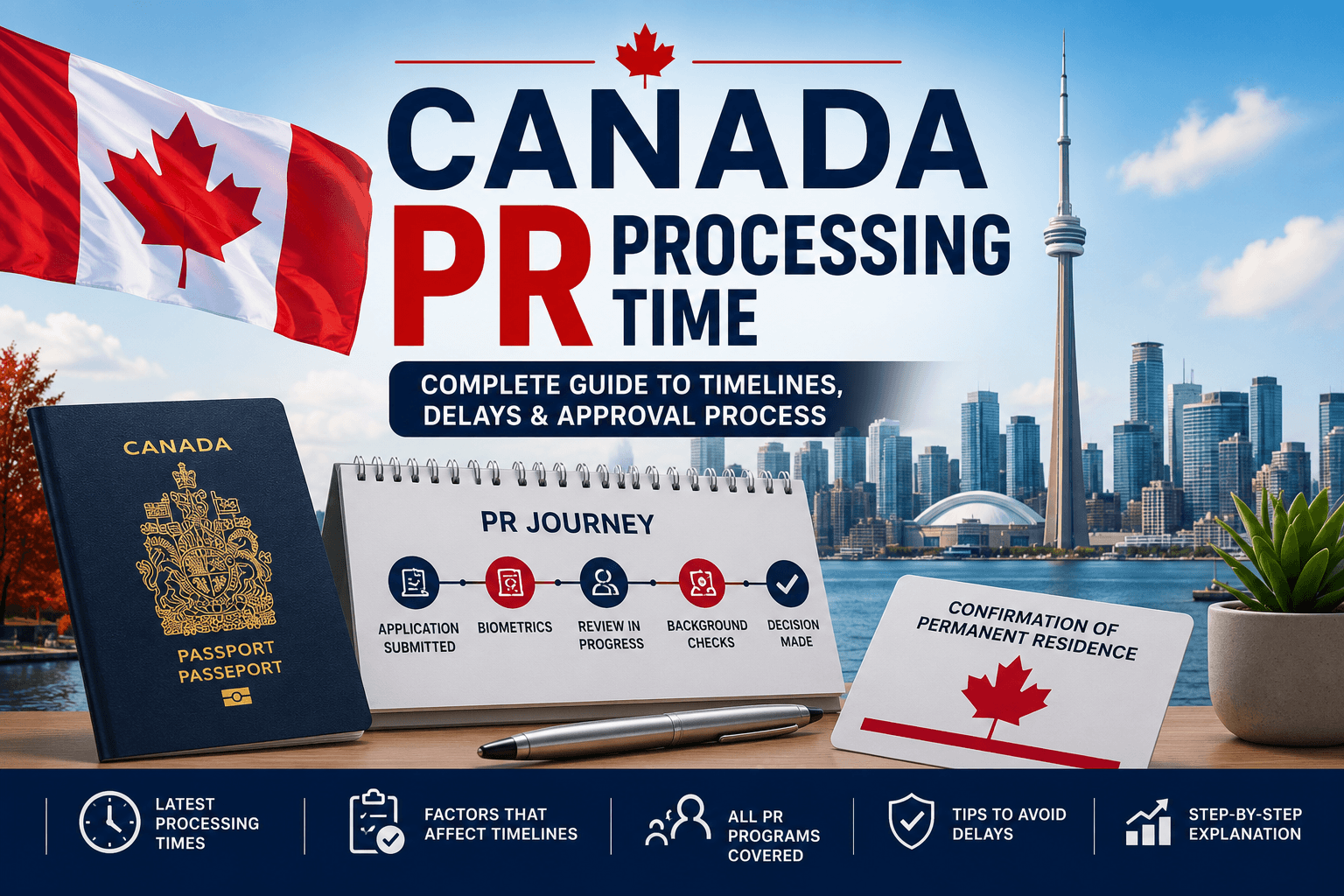
For thousands of immigrants every year, becoming a permanent resident of Canada is more than just obtaining a visa—it’s the beginning of a new chapter. Permanent residence gives eligible foreign nationals the opportunity to live, work, and study anywhere in Canada while enjoying many of the rights and benefits available to Canadian residents.
However, before you can start that journey, one question naturally comes to mind:
How long does Canada PR take to process?
The answer depends on several factors. Unlike many people believe, there is no single processing timeline that applies to every permanent residence application. Processing times vary depending on the immigration program you apply under, your country of residence, the complexity of your application, and whether Immigration, Refugees and Citizenship Canada (IRCC) requires additional documents or verification.
Canada offers several permanent residence pathways, including Express Entry, Provincial Nominee Programs (PNPs), family sponsorship, business immigration, and humanitarian programs. Each stream has its own processing timeline and eligibility requirements.
This guide explains everything you need to know about Canada PR processing times, what influences them, and how you can reduce avoidable delays.
What Is Canadian Permanent Residence?
Permanent residence (PR) allows eligible foreign nationals to live in Canada indefinitely without becoming Canadian citizens immediately.
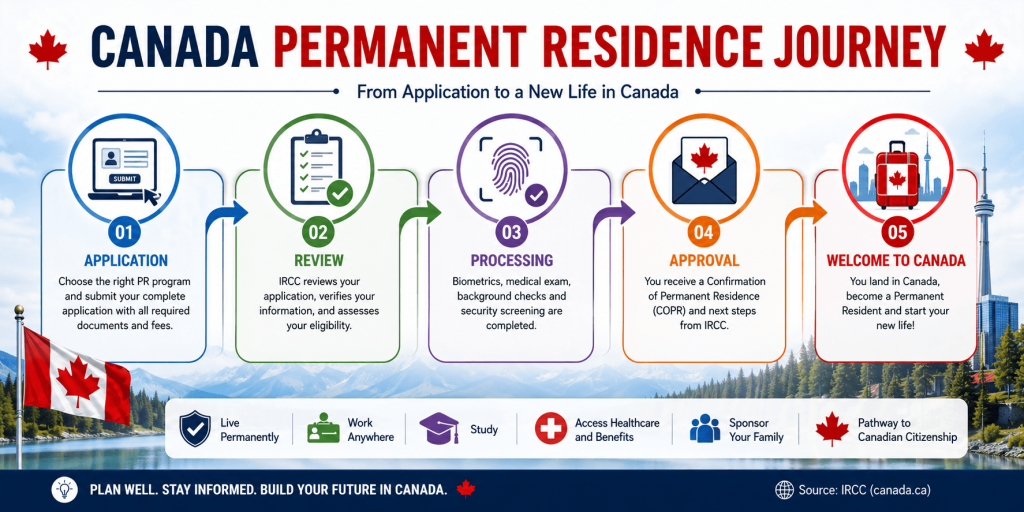
As a permanent resident, you can:
- Live anywhere in Canada.
- Work for almost any employer.
- Study at Canadian institutions.
- Access healthcare services when eligible.
- Sponsor certain family members.
- Apply for Canadian citizenship once you meet the eligibility requirements.
Although permanent residents enjoy many benefits, they must continue to meet residency obligations to maintain their status.
Current Canada PR Processing Time
Canada does not publish one universal processing time for permanent residence applications.
Instead, processing depends on the immigration pathway you choose.
Some of the most common PR programs include:
- Express Entry
- Provincial Nominee Program (PNP)
- Family Sponsorship
- Atlantic Immigration Program
- Rural and Northern Immigration pathways
- Quebec-selected immigration
- Business immigration
Each program follows its own processing standards.
IRCC regularly updates estimated processing times based on recently completed applications, current workload, and available resources.
Applicants should therefore check the official processing time tool before making relocation plans.
How IRCC Calculates Canada PR Processing Times
Many applicants believe their application starts moving immediately after submission.
In reality, IRCC begins by confirming that your application is complete.
Processing generally includes:
- Completeness check
- Eligibility review
- Document verification
- Biometrics (where required)
- Medical examination review
- Criminality assessment
- Security screening
- Final decision
If additional documents are requested, processing may pause until those documents have been received and reviewed.
Factors That Affect Canada PR Processing Time
Every immigration application is unique. Even applicants applying under the same immigration program may receive different processing times.
Several important factors influence how quickly your application moves through the system.
Immigration Program
This is usually the biggest factor.
For example:
- Express Entry applications follow one process.
- Provincial Nominee Programs follow another.
- Family sponsorship applications have different requirements.
- Business immigration applications often involve additional review.
Each pathway has its own processing workflow.
Application Completeness
Submitting a complete application can significantly reduce delays.
Missing documents often result in IRCC requesting additional information.
Common missing documents include:
- Police certificates
- Employment letters
- Educational assessments
- Medical reports
- Financial documents
- Identity documents
A well-organized application is easier for officers to assess.
Country of Residence
Your country of residence may affect where your application is processed.
Different visa offices experience different workloads throughout the year.
As a result, timelines can vary even between applicants using the same immigration program.
Biometrics
Many permanent residence applicants must provide biometrics.
These include:
- Fingerprints
- Digital photograph
Once completed, biometrics allow IRCC to continue identity verification and background assessments.
Medical Examination
Most permanent residence applicants are required to complete an immigration medical examination.
Medical results help determine whether applicants meet Canada’s health requirements.
If additional medical information is needed, processing may take longer.
Background Verification
IRCC verifies the information you submit.
This may include:
- Employment history
- Educational credentials
- Travel history
- Previous immigration records
- Identity documents
Straightforward cases often move through this stage more quickly than applications requiring additional verification.
Security Screening
Every permanent residence applicant undergoes security screening.
Some applications pass this stage quickly, while others require additional assessment.
Applicants cannot influence this process, and timelines vary depending on individual circumstances.
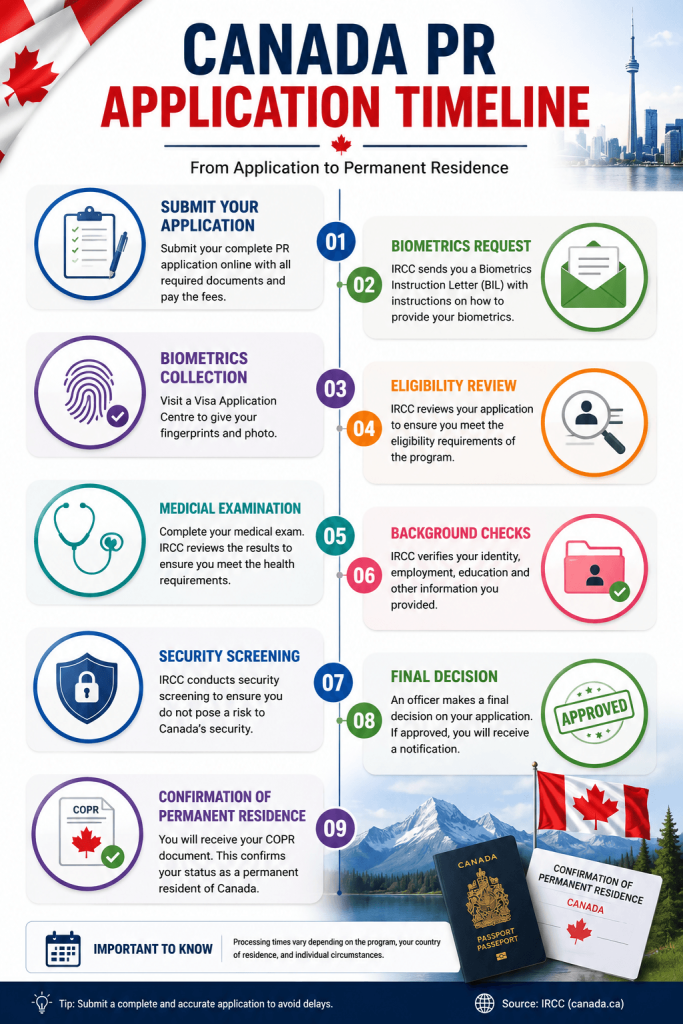
Canada PR Application Timeline
Although processing differs between immigration programs, most permanent residence applications follow a similar sequence.
Step 1: Submit Your Application
You submit your application together with all required supporting documents and fees.
IRCC confirms that your application has been received.
Step 2: Biometrics Request
If biometrics are required, IRCC sends a Biometrics Instruction Letter.
You then book an appointment at an approved Visa Application Centre.
Step 3: Biometrics Collection
Your fingerprints and digital photograph are collected.
This information is securely transmitted to IRCC.
Step 4: Eligibility Review
An immigration officer reviews your application.
During this stage, they assess:
- Immigration program eligibility
- Supporting documents
- Employment history
- Education
- Language results
- Proof of funds where applicable
Step 5: Medical Examination Review
Medical results are reviewed.
If everything is satisfactory, your application moves to the next stage.
Step 6: Background and Security Checks
IRCC completes criminality and security assessments before making a final decision.
Step 7: Final Decision
If approved, you’ll receive confirmation of permanent residence instructions and information about the next steps toward becoming a permanent resident of Canada.
Express Entry Processing Time
Express Entry remains Canada’s most popular pathway for skilled workers.
It manages applications under programs such as:
- Federal Skilled Worker Program
- Canadian Experience Class
- Federal Skilled Trades Program
Express Entry applications typically move through several stages, including profile submission, invitation to apply (ITA), document submission, biometrics, medical examinations, and final assessment.
Applicants should remember that creating an Express Entry profile is only the first step. The processing timeline for permanent residence begins after receiving an Invitation to Apply and submitting a complete PR application.
Provincial Nominee Program (PNP) Processing Time
The Provincial Nominee Program allows Canadian provinces and territories to nominate applicants who meet local labour market needs.
Unlike Express Entry alone, many PNP applications involve two stages:
- Provincial nomination.
- Federal permanent residence application.
Because of these additional steps, applicants should consider both provincial processing and federal processing when planning their move.
Family Sponsorship PR Processing Time
Family sponsorship is one of Canada’s most important immigration pathways. It allows eligible Canadian citizens and permanent residents to sponsor certain family members to become permanent residents.
Eligible relationships may include:
- Spouses
- Common-law partners
- Dependent children
- Parents and grandparents (through eligible programs)
- Certain other relatives in limited circumstances
Family sponsorship applications often involve two separate assessments. First, IRCC determines whether the sponsor meets the eligibility requirements. Next, the department reviews the permanent residence application of the sponsored family member.
Because two applications are reviewed together, processing times may differ from economic immigration programs such as Express Entry.
Applicants should also remember that additional document requests, relationship verification, and medical or security checks may increase the overall processing time.
Canada PR Processing Time After Biometrics
Many applicants assume that completing biometrics means their permanent residence application is almost finished. Unfortunately, that is not always the case.
Biometrics simply allow IRCC to verify your identity. After your fingerprints and photograph have been submitted, your application continues through several important stages.
These stages may include:
- Eligibility review
- Medical assessment
- Criminality checks
- Background verification
- Security screening
- Final decision
Some applicants receive updates within a short period after biometrics, while others may wait much longer depending on their immigration program and personal circumstances.
Rather than comparing your timeline with another applicant’s, focus on ensuring that your application remains complete and that you respond quickly if IRCC contacts you.
If you have already gone through the biometrics process for a temporary visa, you may notice that the overall workflow is similar. For example, our guide on Canada Visitor Visa Processing Time explains how biometrics fit into temporary resident applications, while many of the same identity verification principles also apply during permanent residence processing.
Canada PR Processing Time from Nigeria
Nigeria continues to be one of the leading countries of origin for Canadian permanent residence applicants.
Processing times for Nigerian applicants depend primarily on:
- The immigration program
- Document completeness
- Background verification
- Security screening
- Medical examination
- Current workload
Applicants should avoid relying on social media timelines because every application is unique.
Instead, concentrate on submitting strong supporting documents, including:
- Educational credentials
- Language test results
- Employment records
- Police certificates
- Proof of funds where applicable
- Valid passports
Strong documentation reduces the likelihood of additional document requests, which often extend processing times.
Canada PR Processing Time from India
India remains one of Canada’s largest sources of skilled immigrants.
Applicants from India may apply through several permanent residence programs, including Express Entry and Provincial Nominee Programs.
Although applicants often compare timelines online, IRCC assesses each application individually.
Factors that commonly influence processing include:
Completeness of documentation
Missing information almost always slows processing.
Employment verification
Applicants claiming skilled work experience should ensure their reference letters accurately describe their duties and employment period.
Medical examination
Delays sometimes occur if IRCC requests additional medical information.
Security screening
Security assessments vary depending on individual circumstances and cannot be predicted.
Why Is My Canada PR Application Taking So Long?
Waiting for permanent residence can be stressful, especially if you have already made plans to move.
However, several legitimate reasons may explain longer-than-expected processing.
High Application Volumes
Canada continues to welcome hundreds of thousands of new permanent residents every year.
As application numbers increase, some immigration programs experience temporary backlogs.
Incomplete Documentation
One missing document can significantly delay processing.
Examples include:
- Missing police certificates
- Incorrect employment letters
- Incomplete travel history
- Expired passports
- Missing educational assessments
Before submitting your application, review every document carefully.
Medical Review
Some applicants require additional medical assessments.
IRCC cannot finalize certain applications until medical requirements have been satisfied.
Background Verification
Employment history, education, and identity documents may require additional verification.
Complex cases generally take longer than straightforward applications.
Security Screening
Security screening is one of the least predictable stages of permanent residence processing.
Applicants cannot speed up this process, and IRCC rarely provides detailed updates while security checks are underway.
How to Avoid Canada PR Processing Delays
Although some factors remain outside your control, there are several practical steps you can take to improve your chances of a smooth application.
Submit a Complete Application
Double-check every required document before submission.
Using the official document checklist helps reduce avoidable mistakes.
Ensure Your Documents Match
Your employment records, education, passport, and language test results should all be consistent.
Any discrepancy may lead to additional verification.
Respond Quickly to IRCC Requests
If IRCC requests additional documents or clarification, respond as soon as possible.
Delays in responding often increase the overall processing time.
Keep Your Passport Valid
An expiring passport may complicate processing.
If your passport is due to expire soon, consider renewing it before submitting your application.
Monitor Your Online Account
Regularly check your IRCC account for:
- New messages
- Document requests
- Medical updates
- Biometrics updates
- Final decisions
Missing an important notification can delay your application.
How to Check Your Canada PR Application Status
IRCC allows applicants to monitor the progress of their applications online.
Depending on your stage of processing, you may see updates such as:
- Application received
- Biometrics completed
- Medical examination passed
- Eligibility review in progress
- Background verification
- Final decision
Status updates may not change every day. It is normal for some stages to remain unchanged for extended periods.
Frequently Asked Questions
How long does Canada PR processing take?
Processing times vary depending on the immigration program, your country of residence, and your individual application.
Does biometrics mean my PR application is approved?
No.
Biometrics only confirm your identity. IRCC must still complete eligibility, medical, criminality, and security assessments.
Can I speed up my PR application?
There is no guaranteed way to accelerate processing.
Submitting a complete application and responding promptly to requests remain the best ways to avoid unnecessary delays.
Why is my PR application taking longer than expected?
Common reasons include:
- Missing documents
- High application volumes
- Background verification
- Medical review
- Security screening
Does Express Entry process faster than other PR programs?
Express Entry is generally designed to be efficient, but actual processing depends on the completeness of your application and your individual circumstances.
Can my PR application be refused?
Yes.
Applications may be refused if applicants fail to meet program requirements, submit inaccurate information, or cannot satisfy admissibility requirements.
Can I work in Canada while waiting for PR?
Not automatically.
If you wish to work before receiving permanent residence, you generally need valid authorization, such as a work permit. If you’re considering this route, understanding the Canada Work Permit Processing Time can help you plan your move and employment timeline more effectively.
Can I visit Canada while my PR application is being processed?
In some cases, yes, provided you qualify for temporary entry and meet all visitor requirements.
If you intend to travel before your permanent residence decision, reviewing the Canada Visitor Visa Processing Time can help you understand how long a temporary visa application may take and what factors could affect the timeline.
How can I avoid delays?
Submit accurate information, provide all required documents, monitor your application regularly, and respond quickly to any requests from IRCC.
Final Thoughts
Applying for permanent residence in Canada is one of the most significant steps in an immigrant’s journey. While processing times vary between programs and applicants, understanding how the system works helps you prepare realistic expectations and avoid unnecessary setbacks.
The strongest applications are almost always the ones that are complete, accurate, and supported by well-organized documentation. Although you cannot control every stage—such as security screening or application volumes—you can reduce avoidable delays by following IRCC’s instructions carefully and responding promptly whenever additional information is requested.
Finally, remember that every immigration pathway serves a different purpose. Some applicants first travel to Canada as visitors, while others arrive with employer-sponsored work permits before later becoming eligible for permanent residence. Understanding the timelines for each pathway allows you to make informed decisions and plan your move with greater confidence.
With careful preparation, patience, and accurate information, you’ll be in a much stronger position to navigate Canada’s permanent residence process successfully.