Canada remains one of the world’s most popular destinations for international students. Every year, hundreds of thousands of students choose Canadian colleges and universities because of their globally recognized education system, multicultural environment, and opportunities to gain valuable work experience during and after graduation.
Before beginning your academic journey, however, you’ll usually need a Canadian study permit.
One of the first questions students ask is:
How long does a Canada study permit take to process?
The answer depends on several factors.
There is no single processing time that applies to every applicant. Immigration, Refugees and Citizenship Canada (IRCC) processes study permit applications based on several variables, including your country of residence, the completeness of your application, application volume, medical examinations, background checks, and seasonal demand.
While many applications are processed within the estimated timeframe published by IRCC, others may take longer because additional verification is required.
Understanding how the study permit process works before applying can help you prepare a stronger application and reduce avoidable delays.
This guide explains everything you need to know about Canada study permit processing times, including application stages, biometrics, common delays, and practical tips for international students.
What Is a Canada Study Permit?
A Canada Study Permit is an official document that allows eligible foreign nationals to study at a designated learning institution (DLI) in Canada.
Unlike a visitor visa, a study permit authorizes you to remain in Canada while pursuing eligible educational programs.
Depending on your circumstances, you may also qualify to:
- Study full-time at an approved institution
- Work during your studies if eligible
- Apply for a post-graduation work permit after completing your program, if you meet the requirements
A study permit is different from both a visitor visa and a work permit. If you’re planning to visit Canada before your studies begin, our Canada Visitor Visa Processing Time guide explains how visitor visa applications are processed. Likewise, students planning to work after graduation may find our Canada Work Permit Processing Time guide useful for understanding future immigration options.
Current Canada Study Permit Processing Time
Canada study permit processing times vary depending on the country where you apply.
IRCC updates estimated processing times regularly based on recently completed applications and current workloads.
Several factors influence these estimates, including:
- Country of residence
- Number of applications received
- Seasonal demand
- Complexity of individual applications
- Additional document requests
Applicants should always check the official IRCC processing time tool before making travel arrangements or booking flights.
How Canada Study Permit Processing Works
Many students assume processing begins immediately after they submit their online application.
In reality, IRCC first checks whether your application is complete.
A typical study permit application includes several stages:
- Application submission
- Completeness check
- Biometrics
- Eligibility assessment
- Medical examination review (if required)
- Background verification
- Security screening
- Final decision
If additional documents are requested, processing may pause until those documents have been received and assessed.
Factors That Affect Canada Study Permit Processing Time
Every application is different.
Two students applying to the same university on the same day may still receive decisions weeks apart.
Several important factors influence processing.
Country of Residence
Processing times vary depending on the country where the application is submitted.
Different visa offices experience different workloads throughout the year.
Application Completeness
Incomplete applications remain one of the most common reasons for delays.
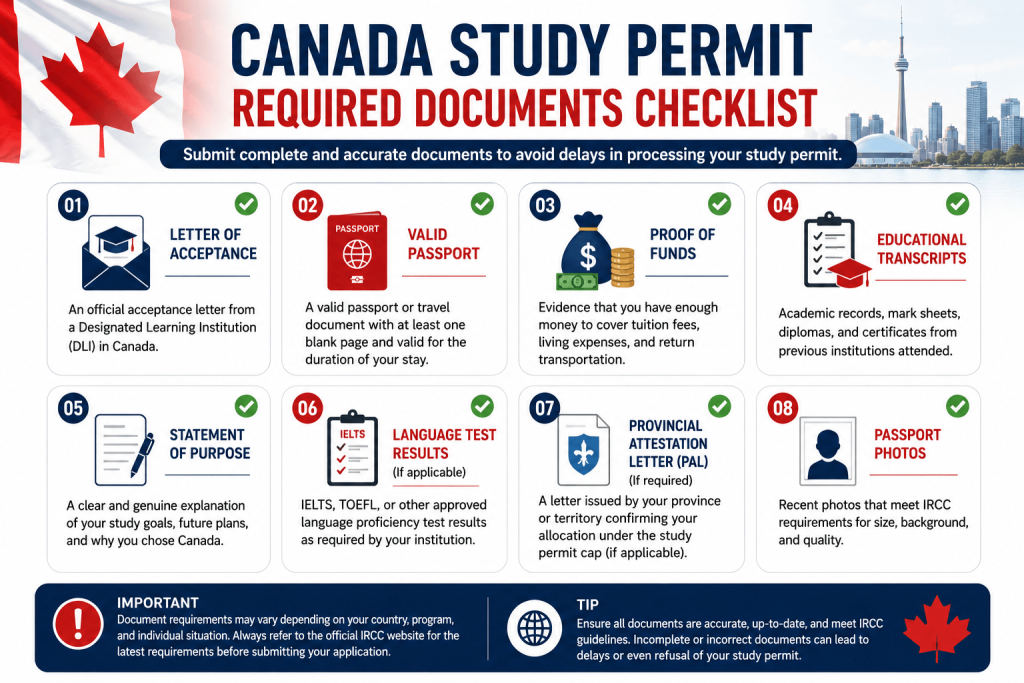
Missing documents may include:
- Letter of Acceptance
- Passport copy
- Proof of funds
- Educational transcripts
- Language test results
- Statement of Purpose
- Provincial Attestation Letter (where applicable)
Submitting every required document at the beginning helps reduce unnecessary delays.
Biometrics
Most international students must provide biometrics.
These include:
- Fingerprints
- Digital photograph
Once biometrics have been collected, IRCC continues reviewing your application.
Medical Examination
Some applicants must complete an immigration medical examination before a decision can be made.
Medical reviews may increase overall processing time, particularly if additional medical information is required.
Background Verification
IRCC reviews the information contained in your application.
This may include:
- Previous education
- Employment history
- Travel history
- Identity documents
- Immigration history
Security Screening
Every study permit application undergoes security screening.
Applicants cannot influence this stage, and timelines vary depending on individual circumstances.
Canada Study Permit Application Timeline
Although every application is unique, most follow a similar process.
Step 1: Receive Your Letter of Acceptance
Before applying for a study permit, you must first receive an official Letter of Acceptance from a Designated Learning Institution (DLI).
Without this document, you generally cannot apply for a study permit.
Step 2: Prepare Your Supporting Documents
Gather all required documentation before submitting your application.
This usually includes:
- Passport
- Letter of Acceptance
- Proof of funds
- Educational records
- Language test results (where applicable)
- Passport photographs
- Statement of Purpose
- Provincial Attestation Letter, if required under current rules
Step 3: Submit Your Online Application
Complete your study permit application online, upload your supporting documents, and pay the required government fees.
Once submitted, IRCC acknowledges receipt of your application.
Step 4: Complete Biometrics
If biometrics are required, you’ll receive a Biometrics Instruction Letter.
Visit an approved Visa Application Centre to provide your fingerprints and photograph.
Completing biometrics allows IRCC to continue processing your application.
Step 5: Eligibility Assessment
An immigration officer reviews your application.
During this stage, they assess:
- Your chosen study program
- Letter of Acceptance
- Financial ability
- Educational background
- Purpose of study
- Intention to leave Canada when required
- Supporting documents
A clear and well-organized application is generally easier to assess.
Step 6: Medical Examination Review
If a medical examination is required, IRCC reviews the results before continuing.
Applicants may receive additional medical requests if further assessment is needed.
Step 7: Background and Security Checks
IRCC completes background verification and security screening before making a final decision.
The duration of this stage varies between applicants.
Step 8: Final Decision
If your application is approved, IRCC issues instructions regarding your Port of Entry Letter of Introduction and any other required travel documents.
Your actual study permit is generally issued by a border services officer when you arrive in Canada and meet all entry requirements.
Proof of Funds and Why It Matters
One of the most important parts of your study permit application is demonstrating that you can financially support yourself while studying in Canada.
Visa officers want to be satisfied that you have enough money to pay for:
- Tuition fees
- Living expenses
- Accommodation
- Transportation
- Return travel, if necessary
Proof of funds may include:
- Bank statements
- Guaranteed Investment Certificate (GIC), where applicable
- Scholarship letters
- Student loan approval
- Sponsor’s financial documents
- Proof of income
Weak financial documentation is one of the most common reasons for delays and refusals.
Provincial Attestation Letter (PAL)
Depending on current Canadian immigration policies and your type of application, you may need to include a Provincial Attestation Letter (PAL).
A PAL confirms that your province or territory has allocated a study permit space for your application.
Not every applicant requires one, but if it applies to your situation, failing to include it could prevent your application from being processed.
Canada Study Permit Processing Time After Biometrics
Completing your biometrics appointment is an important step, but it does not mean your study permit has been approved.
Many applicants expect a decision within a few days after providing their fingerprints and photograph. While some applications move quickly, others continue through several stages before a final decision is made.
Once your biometrics have been successfully received, IRCC continues assessing your application.
This may include:
- Eligibility review
- Verification of supporting documents
- Medical examination review (if required)
- Background verification
- Security screening
- Final officer assessment
The amount of time spent at each stage varies depending on your application.
Canada Study Permit Processing Time from India
India remains Canada’s largest source of international students.
Thousands of Indian students apply every year to attend Canadian colleges and universities.
Processing times for Indian applicants vary depending on:
- Time of year
- Number of applications
- Medical examinations
- Completeness of documents
- Background verification
- Individual circumstances
Applicants should avoid relying on processing timelines shared on social media because every application is different.
Instead, focus on submitting a complete application supported by strong financial evidence and accurate documentation.
Students from India should ensure they provide:
- Letter of Acceptance
- Valid passport
- Proof of funds
- Academic transcripts
- Language test results (where applicable)
- Statement of Purpose
- Provincial Attestation Letter if required
Canada Study Permit Processing Time from Nigeria
Canada has become an increasingly popular study destination for Nigerian students.
Processing times for Nigerian applicants vary depending on several factors, including application volume and document verification.
Applicants should pay particular attention to financial documentation.
Strong evidence may include:
- Bank statements
- Sponsorship letters
- Scholarship awards
- Student loan approvals
- Income documents
Applicants should also ensure that their educational history clearly supports their chosen program of study.
Well-organized documentation reduces the likelihood of additional document requests.
Why Is My Canada Study Permit Taking So Long?
Many students become concerned when several weeks pass without receiving an update.
Fortunately, longer processing does not automatically mean your application will be refused.
Several legitimate reasons may explain a longer timeline.
High Application Volumes
Canada receives hundreds of thousands of study permit applications each year.
The busiest periods often occur before:
- September intake
- January intake
- May intake
Applications submitted close to these intakes may experience longer processing because of increased demand.
Medical Examination Delays
Some students must complete immigration medical examinations.
If further assessment is required, processing may continue for longer than expected.
Additional Document Requests
IRCC may request additional documents if something is unclear.
Examples include:
- Updated proof of funds
- New passport copy
- Additional educational documents
- Updated admission letter
- Sponsor documents
Processing generally pauses until the requested information has been reviewed.
Financial Verification
Study permit applications require applicants to demonstrate sufficient financial resources.
If financial evidence requires additional review, processing may take longer.
Background Verification
IRCC verifies information submitted in your application.
This may include:
- Previous education
- Employment history
- Travel records
- Identity documents
Straightforward cases generally move through this stage more quickly.
Security Screening
Every study permit applicant undergoes security screening.
Applicants cannot influence this process, and timelines differ from one case to another.
How to Avoid Canada Study Permit Processing Delays
Although some delays remain outside your control, several practical steps can improve your application.
Apply Early
Do not wait until a few weeks before your classes begin.
Submitting your application several months before your intended intake provides enough time if IRCC requests additional information.
Submit Complete Documents
Before submitting your application, ensure that every required document has been uploaded.
Common documents include:
- Passport
- Letter of Acceptance
- Proof of funds
- Educational transcripts
- Language test results
- Statement of Purpose
- Provincial Attestation Letter where required
Write a Strong Statement of Purpose
Your Statement of Purpose helps explain:
- Why you chose Canada
- Why you selected your institution
- Your future career plans
- Why you intend to return home if required
A clear and well-written statement helps the officer understand your application.
Demonstrate Strong Financial Capacity
Financial evidence should clearly show that you can support yourself throughout your studies.
Avoid submitting incomplete or inconsistent financial documents.
Respond Quickly to IRCC Requests
If IRCC requests additional information, upload the requested documents as soon as possible.
Delays in responding usually increase overall processing time.
How to Track Your Canada Study Permit Application
After submitting your application, you can monitor its progress through your online IRCC account.
Common status updates include:
- Application submitted
- Biometrics requested
- Biometrics completed
- Eligibility review
- Medical examination passed
- Background verification
- Final decision
It is perfectly normal for your status to remain unchanged for several days or weeks while your application is under review.
Frequently Asked Questions
How long does a Canada study permit take?
Processing times vary depending on your country of residence, application volume, medical examinations, and individual circumstances.
Does biometrics mean my study permit is approved?
No.
Biometrics only verify your identity.
IRCC must still complete eligibility assessment, medical review, background verification, security screening, and the final officer review.
Can I speed up my study permit application?
There is generally no standard expedited service.
Submitting a complete application with accurate documentation is the best way to reduce avoidable delays.
Why is my study permit taking longer than expected?
Common reasons include:
- High application volume
- Medical examination review
- Financial verification
- Background checks
- Missing documents
- Additional information requests
Can I work while studying in Canada?
Many international students may be eligible to work while studying if they meet the conditions of their study permit.
Students planning to remain in Canada after graduation may later apply for a work permit. Our Canada Work Permit Processing Time guide explains how that process works.
Can my study permit be refused?
Yes.
Applications may be refused if the applicant cannot satisfy eligibility requirements, provide sufficient financial evidence, demonstrate a genuine study purpose, or meet admissibility requirements.
Do I need a Provincial Attestation Letter?
Depending on current immigration rules and your circumstances, a Provincial Attestation Letter may be required.
Always review the latest IRCC guidance before submitting your application.
What happens after my study permit is approved?
If approved, you’ll typically receive a Port of Entry Letter of Introduction.
Your actual study permit is generally issued when you arrive in Canada and meet the entry requirements.
Can I visit Canada before my studies begin?
Some students may travel shortly before their program starts if they have the necessary travel authorization.
If you are entering Canada as a temporary visitor before your studies, understanding the Canada Visitor Visa Processing Time can help you plan your travel more effectively.
Can I become a permanent resident after studying in Canada?
Many international graduates later qualify for permanent residence through programs such as Express Entry or Provincial Nominee Programs.
If permanent immigration is part of your long-term plan, our Canada PR Processing Time guide explains what to expect after submitting a PR application.
Final Thoughts
A Canada study permit is much more than a travel document—it’s the first step toward an internationally recognized education and, for many students, the beginning of a long-term future in Canada.
Although processing times vary depending on your country of residence, application volume, medical examinations, and background checks, careful preparation can significantly reduce avoidable delays.
The strongest applications are complete, well-organized, and supported by clear financial evidence, a genuine study plan, and accurate documentation. Rather than comparing your timeline with other applicants online, focus on ensuring your own application meets every requirement outlined by IRCC.
Most importantly, apply as early as possible. Waiting until the last minute before your intended intake increases the risk of missing important deadlines if additional documents or medical examinations are required.
With careful planning, realistic expectations, and a complete application, you’ll put yourself in the best possible position to receive your study permit and begin your academic journey in Canada.