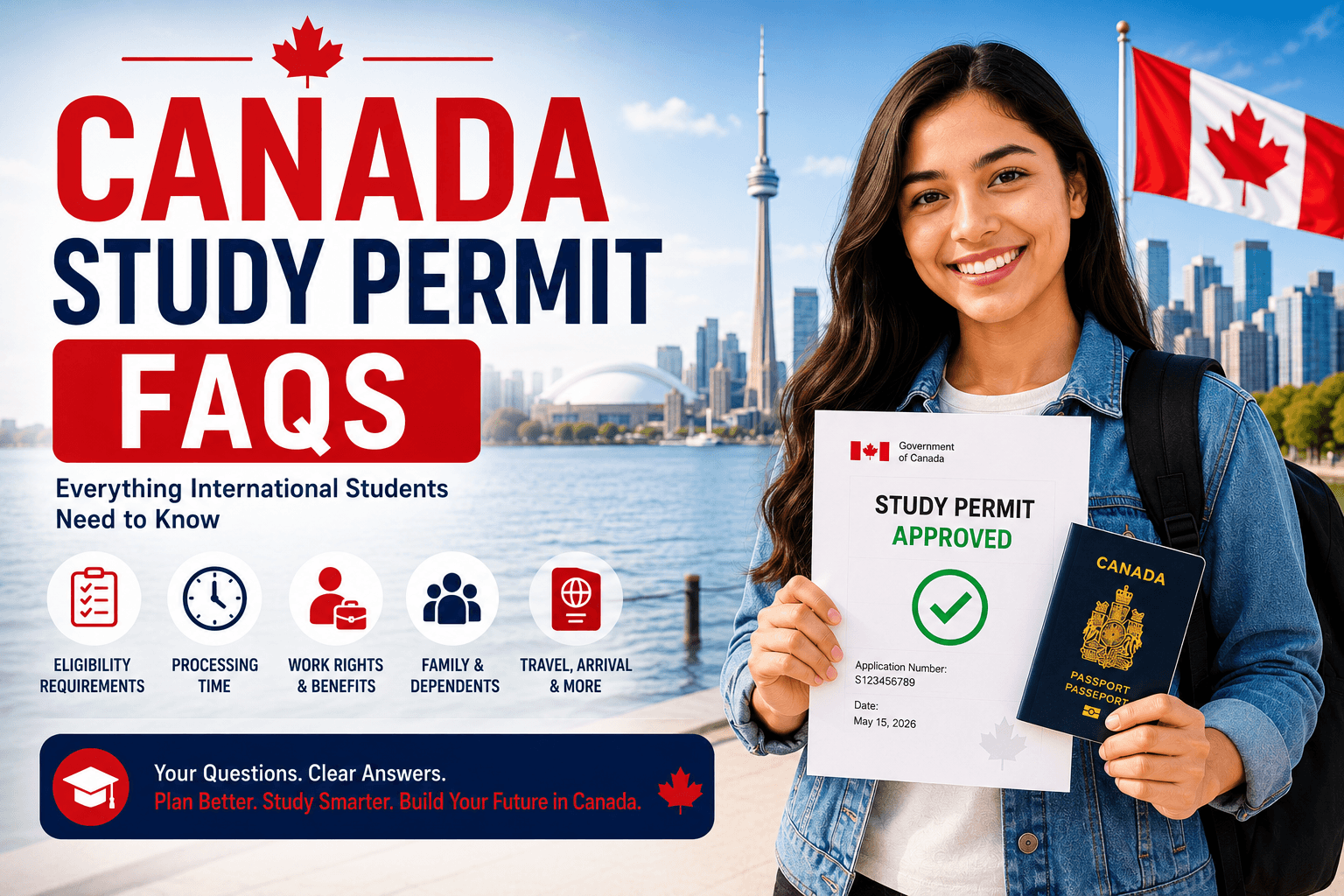
Canada is one of the world’s most popular destinations for international students, offering high-quality education, globally recognized qualifications, and opportunities to gain valuable work experience during and after graduation.
If you’re planning to study in Canada, you probably have many questions about the study permit process.
Questions like:
- Who needs a study permit?
- How long does processing take?
- Do I need biometrics?
- Can I work while studying?
- What happens after approval?
- Can my family come with me?
Understanding the answers before you apply can help you avoid mistakes, reduce delays, and prepare a stronger application.
This guide answers the most frequently asked questions about Canadian study permits in simple, easy-to-understand language.
1. What Is a Canada Study Permit?
A Canada Study Permit is an official document issued by Immigration, Refugees and Citizenship Canada (IRCC) that allows eligible foreign nationals to study at a designated learning institution (DLI) in Canada.
A study permit is not the same as a visa.
Depending on your nationality, you may also need either:
- A Temporary Resident Visa (TRV), or
- An Electronic Travel Authorization (eTA)
to travel to Canada.
2. Who Needs a Canada Study Permit?
Most international students need a study permit before beginning their studies in Canada.
However, some short-term courses or specific situations may be exempt from this requirement.
Always confirm your eligibility before making travel arrangements.
3. What Is a Designated Learning Institution (DLI)?
A Designated Learning Institution (DLI) is a school approved by a provincial or territorial government to host international students.
Before applying for a study permit, make sure your chosen institution appears on Canada’s official DLI list.
4. How Do I Apply for a Canada Study Permit?
Most applicants apply online through their IRCC account.
The general process includes:
- Obtain a Letter of Acceptance (LOA)
- Gather supporting documents
- Complete the application forms
- Pay the required fees
- Submit your application
- Complete biometrics (if required)
- Complete a medical examination (if required)
- Wait for IRCC’s decision
5. What Documents Are Required?
Although document requirements vary, applicants commonly submit:
- Valid passport
- Letter of Acceptance (LOA)
- Passport photographs
- Proof of financial support
- Educational documents
- Statement of Purpose (where applicable)
- Language test results (if applicable)
- Medical examination confirmation (if required)
Providing complete documentation helps reduce delays.
6. How Long Does Canada Study Permit Processing Take?
Processing times vary depending on:
- Country of application
- Time of year
- Application volume
- Biometrics
- Medical examination
- Background verification
IRCC regularly updates estimated processing times online.
7. Do I Need to Give Biometrics?
Most applicants are required to provide:
- Fingerprints
- Digital photograph
Biometrics verify your identity and are usually collected at a Visa Application Centre (VAC).
Completing biometrics does not mean your study permit has been approved.
8. Do I Need a Medical Examination?
Some applicants are required to complete an immigration medical examination.
This depends on several factors, including your country of residence and personal circumstances.
If required, complete the examination promptly to help avoid unnecessary delays.
9. How Much Money Do I Need?
Applicants must show that they have enough financial resources to cover:
- Tuition fees
- Living expenses
- Accommodation
- Return transportation
IRCC reviews financial evidence carefully before approving a study permit.
10. Can I Work While Studying?
Many international students are permitted to work while studying if they meet the conditions printed on their study permit.
Always review your permit carefully to understand your work authorization and any applicable restrictions.
11. Can My Spouse or Children Come With Me?
In many cases, yes.
Depending on your circumstances:
- Your spouse or common-law partner may qualify for an open work permit.
- Your dependent children may be eligible to accompany you and, in some cases, attend school in Canada.
12. What Happens After My Study Permit Is Approved?
If you require a Temporary Resident Visa (TRV), IRCC will usually send you a Passport Request (PPR).
After your passport has been stamped, you’ll receive instructions for travelling to Canada.
Your actual study permit is generally issued by a Canada Border Services Agency (CBSA) officer when you arrive at a Canadian port of entry.
13. Can I Extend My Study Permit?
Yes.
If you plan to continue studying beyond the validity of your current permit, you should apply for an extension before it expires.
Applying early helps you maintain your legal status while your extension application is being processed.
14. Can I Change Schools or Programs?
Yes, in many situations.
However, you should ensure that your new institution is a Designated Learning Institution and that you comply with all IRCC requirements when making changes to your studies.
15. What Happens If My Study Permit Is Refused?
If your application is refused, IRCC will normally explain the reason.
Depending on your circumstances, you may choose to:
- Correct the issues identified
- Gather stronger supporting documents
- Submit a new application if appropriate
Understanding the reason for refusal can help you prepare a stronger application in the future.
16. Can a Study Permit Lead to Permanent Residence?
A study permit does not automatically lead to permanent residence.
However, many international students later qualify for immigration pathways after completing their studies and gaining eligible work experience in Canada.
17. Where Can I Check My Application Status?
You can monitor your application by signing in to your online IRCC account.
Common status updates include:
- Application submitted
- Biometrics completed
- Medical passed
- Eligibility review
- Background verification
- Final decision
- Passport Request (if approved)
18. What Is the Best Way to Improve My Chances of Approval?
Some of the best ways to strengthen your application include:
- Submit complete and accurate documents.
- Provide strong financial evidence.
- Explain your study plans clearly.
- Complete biometrics and medical requirements promptly.
- Respond quickly to IRCC requests.
- Apply well before your intended program start date.
19. Can I Apply for a Canada Study Permit Without IELTS?
It depends on the institution and your individual circumstances.
IRCC does not require every applicant to submit an IELTS score for a study permit. However, many Canadian colleges and universities require proof of English or French language proficiency as part of their admission process.
If your institution accepts another approved language test or grants an exemption, you may not need IELTS for admission.
Always check your school’s admission requirements before applying.
20. Can I Apply for a Study Permit Without Paying My Tuition?
Many institutions require a tuition deposit before issuing a Letter of Acceptance or confirming enrollment.
While tuition payment requirements may vary depending on your institution and application pathway, providing proof of tuition payment can strengthen your study permit application.
21. Can I Bring My Family While Studying?
Yes, many international students are able to bring eligible family members to Canada.
Depending on your circumstances:
- Your spouse or common-law partner may qualify for an open work permit.
- Your dependent children may be eligible to study at Canadian schools.
Each family member must meet the applicable immigration requirements.
22. Can I Leave and Re-enter Canada While Studying?
If you leave Canada temporarily, you must ensure that you have the required travel documents to return.
This may include:
- A valid passport
- A valid study permit
- A valid Temporary Resident Visa (TRV) or Electronic Travel Authorization (eTA), if required
Always confirm that your documents remain valid before travelling.
23. Can I Work Full-Time During School Breaks?
Many international students are allowed to work full-time during scheduled academic breaks if they meet the conditions of their study permit.
Always review the work conditions printed on your study permit and stay informed about the latest IRCC rules.
24. What Happens If My Passport Expires?
Your passport should remain valid throughout your studies.
If your passport expires, you should renew it as soon as possible and update your immigration records where required.
An expiring passport may affect the length of your study permit.
25. What Should I Bring When Travelling to Canada?
When travelling, keep your important documents in your carry-on luggage.
These commonly include:
- Passport
- Port of Entry Letter of Introduction
- Letter of Acceptance
- Proof of financial support
- Tuition payment receipts
- Accommodation details
- Medical records (if applicable)
- Contact information for your school
Border officers may ask to review these documents before issuing your study permit.
26. What Happens at the Canadian Airport?
When you arrive in Canada, a Canada Border Services Agency (CBSA) officer will review your documents.
If everything is in order, the officer will issue your official study permit.
Before leaving the airport, carefully review your permit to confirm:
- Your name is correct.
- Your passport number is correct.
- The expiry date is accurate.
- Any work conditions are correctly listed.
If you notice an error, inform the officer immediately.
27. Can I Stay in Canada After Graduation?
Many international graduates may qualify for a Post-Graduation Work Permit (PGWP), provided they meet the eligibility requirements.
A PGWP can allow graduates to gain valuable Canadian work experience, which may later support an application for permanent residence through an eligible immigration pathway.
28. Can My Study Permit Be Cancelled?
Yes.
A study permit may become invalid or be cancelled if you no longer meet the conditions attached to it.
For example, students are generally expected to:
- Remain enrolled at an eligible institution.
- Make reasonable progress toward completing their studies.
- Follow the conditions printed on their study permit.
- Maintain valid immigration status while in Canada.
29. What Are the Most Common Reasons for Study Permit Refusal?
Study permit applications may be refused for a variety of reasons.
Common examples include:
- Insufficient financial evidence
- Incomplete documentation
- Weak study plan
- Concerns about the purpose of study
- Missing supporting documents
- Inconsistencies in the application
- Failure to satisfy an immigration officer that the applicant will comply with the conditions of the permit
Carefully preparing your application can help reduce these risks.
30. What Is the Best Time to Apply for a Canada Study Permit?
Applying as early as possible is generally recommended.
Early applications provide more time to complete:
- Biometrics
- Medical examinations
- Document requests
- Passport submission (if required)
- Travel planning
Waiting until the last minute increases the risk of missing your intended intake.
Common Mistakes to Avoid
Many study permit delays and refusals can be avoided by preparing carefully.
Some common mistakes include:
- Submitting incomplete documents
- Providing inconsistent financial information
- Waiting too long to apply
- Ignoring requests from IRCC
- Uploading poor-quality document scans
- Allowing your passport to expire
- Failing to explain your study plans clearly
Avoiding these mistakes can improve your chances of a smoother application process.
Canada Study Permit Checklist
Before submitting your application, make sure you have:
✔ Valid passport
✔ Letter of Acceptance (LOA)
✔ Proof of financial support
✔ Tuition payment evidence (where applicable)
✔ Educational documents
✔ Passport photographs
✔ Biometrics appointment (if required)
✔ Medical examination (if required)
✔ Complete application forms
✔ Government fee payment confirmation
Final Tips Before Travelling
Once your application has been approved:
- Verify all information on your visa and study permit documents.
- Carry your important documents in your hand luggage.
- Keep copies of your documents in digital format.
- Review your institution’s arrival instructions.
- Arrange accommodation before travelling.
- Purchase health insurance if required.
- Plan to arrive before your classes begin.
Good preparation helps make your arrival in Canada much smoother.
Final Thoughts
Canada continues to be one of the world’s leading destinations for international education because of its high-quality institutions, welcoming environment, and opportunities for students to gain valuable academic and professional experience.
Understanding the study permit process before you apply can help you avoid unnecessary delays, prepare stronger documentation, and feel more confident throughout your journey. From gathering your Letter of Acceptance and financial documents to completing biometrics, medical examinations, and arriving at your port of entry, every step plays an important role in a successful application.
By planning ahead, submitting complete and accurate information, and staying informed about current IRCC requirements, you’ll place yourself in the strongest possible position to begin your studies in Canada successfully.