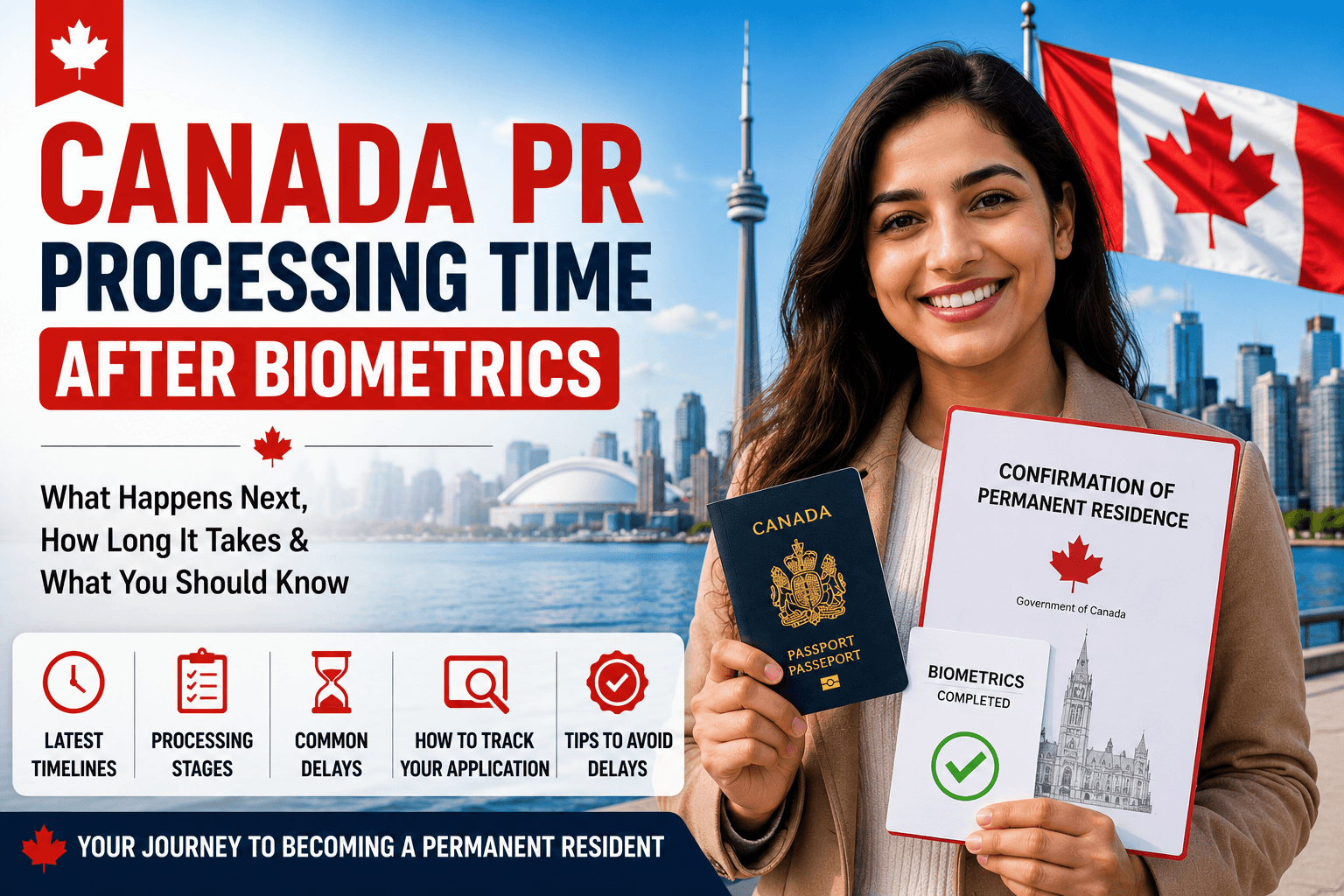
Completing your biometrics appointment is one of the biggest milestones in your Canadian Permanent Residence (PR) application. After months of preparing documents, submitting forms, and paying application fees, many applicants expect a decision shortly after providing their fingerprints and photograph.
However, biometrics are only one step in the permanent residence process.


One of the questions applicants ask most frequently is:
“How long does Canada PR take after biometrics?”
The answer depends on several factors.
Some applicants receive their Confirmation of Permanent Residence (COPR) relatively quickly after biometrics, while others wait considerably longer because their application requires additional review.
After biometrics, Immigration, Refugees and Citizenship Canada (IRCC) continues assessing your eligibility, medical results, background verification, security screening, and supporting documents before making a final decision.
Understanding what happens during this stage can help you set realistic expectations and avoid unnecessary anxiety while waiting.
This guide explains every stage after biometrics, why applications are sometimes delayed, how to track your application, and what happens once your permanent residence is approved.
What Are Biometrics?
Biometrics are personal identification details collected by IRCC to verify your identity.
Most applicants provide:
- Fingerprints
- Digital photograph
Biometrics help IRCC:
- Confirm your identity
- Prevent immigration fraud
- Match previous immigration records
- Strengthen border security
- Protect Canada’s immigration system
Providing biometrics is mandatory for most permanent residence applicants.
However, completing biometrics does not mean your permanent residence has been approved.
What Happens Immediately After Biometrics?
Once your fingerprints and photograph have been submitted at a Visa Application Centre (VAC), your biometric information is securely transmitted to IRCC.
Your application then returns to the immigration officer responsible for your case.
Several important assessments still remain before a final decision can be made.
These generally include:
- Eligibility assessment
- Medical examination review
- Supporting document review
- Background verification
- Security screening
- Final officer review
- Permanent residence decision
Every application progresses differently.
Two applicants who completed biometrics on the same day may receive their approvals weeks or even months apart because every case is assessed individually.
Canada PR Processing Stages After Biometrics
Understanding these stages helps explain why processing times vary.
Eligibility Assessment
An immigration officer first determines whether you qualify under the immigration program through which you applied.
This may include:
- Express Entry
- Provincial Nominee Program (PNP)
- Family Sponsorship
- Atlantic Immigration Program
- Rural and Northern Immigration Pilot
- Other permanent residence pathways
During this stage, officers review:
- Eligibility requirements
- Supporting documents
- Employment history
- Educational credentials
- Language test results
- Immigration history
Medical Examination Review
Many PR applicants must complete an immigration medical examination.
IRCC reviews the results to determine whether applicants meet Canada’s medical admissibility requirements.
If additional testing or clarification is required, processing may take longer.
Supporting Document Review
IRCC carefully examines every uploaded document.
Examples include:
- Passport
- Police certificates
- Educational Credential Assessment (ECA)
- Language test results
- Employment letters
- Proof of funds
- Civil status documents
If any document is unclear or missing, IRCC may request additional information.
Background Verification
IRCC verifies information relating to:
- Previous immigration records
- Employment history
- Travel history
- Identity documents
- Supporting evidence
Straightforward applications generally progress more quickly.
Security Screening
Every permanent residence applicant undergoes security screening before approval.
Applicants cannot influence this process.
Final Officer Review
After every required assessment has been completed, an immigration officer performs the final review.
The officer confirms that:
- Eligibility requirements have been met.
- Medical requirements have been satisfied.
- Background verification has been completed.
- Security screening has been completed.
- Supporting documents are sufficient.
Once satisfied, IRCC proceeds to the final decision.
How Long Does Canada PR Take After Biometrics?
There is no fixed timeline after biometrics.
The waiting period depends on several factors, including:
- Immigration program
- Country of residence
- Application complexity
- Medical examination
- Background verification
- Security screening
- Additional document requests
Rather than comparing your timeline with applicants on online forums, it’s better to monitor your own application through your IRCC account.
If you’re still preparing your application or want to understand the entire process from submission to approval, our Canada PR Processing Time guide provides a complete overview of every stage.
Why Some PR Applications Move Faster
Although no applicant can guarantee faster processing, several factors often contribute to smoother assessments.
Complete Documentation
Applications containing clear and complete documentation are generally easier for officers to assess.
Examples include:
- Valid passport
- Police certificates
- Educational documents
- Employment records
- Proof of funds
- Medical examination confirmation
Straightforward Immigration History
Applicants with simple immigration histories usually require fewer additional checks.
No Additional Document Requests
Applications that contain every required document from the beginning are less likely to experience avoidable delays.
Medical Results Already Accepted
If your medical examination has already been reviewed and accepted by IRCC, your application can continue without waiting for additional medical assessment.
Why Is My Canada PR Application Taking So Long After Biometrics?
Waiting after completing your biometrics is often the most difficult part of the permanent residence process. Once your fingerprints and photograph have been submitted, most of the remaining work happens behind the scenes, leaving many applicants wondering whether their application is progressing normally.
The good news is that a longer processing time does not necessarily indicate a problem with your application.
Every permanent residence application is unique, and some require additional assessment before a final decision can be made.
Below are the most common reasons why a Canada PR application may take longer after biometrics.
Eligibility Verification
One of the first stages after biometrics is confirming that you still meet the requirements of the immigration program under which you applied.
Depending on your pathway, IRCC may verify:
- Work experience
- Educational credentials
- Language test results
- Provincial nomination
- Family sponsorship eligibility
- Settlement funds
If additional verification is required, processing may take longer.
Medical Examination Review
Most permanent residence applicants must complete an immigration medical examination.
IRCC reviews the results to determine whether applicants meet Canada’s health admissibility requirements.
Processing may take longer if:
- Additional medical tests are required
- Further specialist reports are requested
- Medical results expire before a decision is made
Applicants cannot influence the speed of this assessment.
Background Verification
IRCC carefully reviews information relating to your personal and immigration history.
This may include:
- Employment history
- Previous visas
- Travel history
- Identity documents
- Immigration records
- Supporting documentation
Applicants with straightforward histories often progress more quickly.
Security Screening
Every permanent residence applicant undergoes security screening before approval.
Security screening is conducted separately from eligibility assessment and background verification.
The amount of time required varies significantly depending on individual circumstances.
Applicants cannot request expedited security screening.
Additional Document Requests
Sometimes IRCC requires further information before making a final decision.
Common requests include:
- Updated passport
- New police certificates
- Updated proof of funds
- Additional employment letters
- New medical examination
- Revised civil status documents
Processing generally pauses until the requested documents have been received and reviewed.
High Application Volume
Canada continues to receive record numbers of permanent residence applications each year.
Large application volumes under programs such as:
- Express Entry
- Provincial Nominee Program
- Family Sponsorship
- Atlantic Immigration Program
may contribute to longer processing times during certain periods.
What Should You Do While Waiting?
Although waiting can feel frustrating, there are several practical steps you can take while your application is being processed.
Monitor Your IRCC Account
Check your online account regularly for updates.
Typical status updates include:
- Biometrics completed
- Eligibility review
- Medical examination passed
- Background verification
- Final decision
It is perfectly normal for your application status to remain unchanged for several weeks.
Check Your Email Frequently
IRCC may contact you if additional documents are required.
Responding promptly helps prevent unnecessary delays.
Keep Your Documents Current
If your passport, police certificate, or other important document is about to expire, prepare updated copies in case IRCC requests them.
Avoid Multiple Webforms
Submitting repeated case-specific enquiries generally does not speed up processing.
Unless your circumstances have changed significantly, it is usually best to wait for IRCC to continue processing your application.
Understanding Common IRCC Status Updates
Applicants often worry because their application appears unchanged for long periods.
Below are the most common updates.
Biometrics Completed
IRCC has successfully received your fingerprints and photograph.
This does not indicate approval.
Eligibility Review
An immigration officer is reviewing your eligibility under the immigration program through which you applied.
Medical Examination Passed
IRCC has accepted your medical examination results.
Your application then proceeds to the remaining assessments.
Background Verification
IRCC is reviewing your immigration history, employment history, travel records, and identity information.
This stage may last several weeks depending on your individual circumstances.
Final Decision
The immigration officer has completed all required assessments.
If approved, you’ll receive instructions regarding the next stage of your permanent residence application.
What Happens After Canada PR Is Approved?
Once your application has been approved, IRCC begins the final immigration process.
Depending on where you applied, you may receive:
- Passport Request (PPR)
- Confirmation of Permanent Residence (COPR)
- Permanent Resident Portal invitation (for eligible applicants inside Canada)
- Landing instructions
Applicants outside Canada may be asked to submit their passport so that the necessary travel documentation can be issued.
Applicants already inside Canada may instead complete their landing electronically through the Permanent Resident Portal.
Before travelling or completing your landing, carefully verify:
- Your name
- Passport number
- Date of birth
- Validity dates
- Personal information
Report any errors immediately.
Frequently Asked Questions
How long does Canada PR take after biometrics?
There is no fixed timeline.
Processing depends on your immigration program, application complexity, medical examination, background verification, and security screening.
Does biometrics mean my PR is approved?
No.
Biometrics only verify your identity.
IRCC must still complete eligibility assessment, medical review, background verification, security screening, and the final officer review.
Why has my application not changed for several weeks?
This is common.
Many permanent residence applications remain under review for extended periods while IRCC completes internal assessments.
Can I speed up my PR application after biometrics?
Generally, no.
Once biometrics have been completed, applicants cannot usually accelerate processing unless IRCC specifically prioritizes their application.
What is Passport Request (PPR)?
Passport Request is a communication from IRCC asking eligible applicants outside Canada to submit their passport so that the appropriate immigration documents can be issued.
Receiving a Passport Request is generally one of the final stages before becoming a permanent resident.
What is COPR?
Confirmation of Permanent Residence (COPR) is the official document confirming that your permanent residence application has been approved.
You’ll use this document during the landing process.
What happens after receiving COPR?
Depending on your location, you’ll either:
- Complete your landing through the Permanent Resident Portal, or
- Present your COPR to a border services officer when entering Canada.
Will IRCC contact me if additional documents are required?
Yes.
If more information is needed, IRCC will normally contact you through your online account or by email.
Can I work while waiting for my PR decision?
That depends on your current immigration status.
Some applicants may already hold valid work authorization, while others must wait until they receive the appropriate permit. If you’re working under temporary status, our Canada Open Work Permit Processing Time and Canada Work Permit Processing Time guides explain how those applications are processed.
Can I travel while my PR application is being processed?
Travel may be possible depending on your current immigration status and travel documents.
However, ensure you can continue meeting any residency or document requirements before leaving Canada.
Final Thoughts
Completing your biometrics is a major milestone, but it is not the final step in becoming a Canadian permanent resident. After biometrics, IRCC still needs to complete several important assessments, including eligibility verification, medical review, background checks, security screening, and a final officer review.
For many applicants, this waiting period can feel uncertain because updates are often limited. In most cases, however, a lack of movement in your online account is perfectly normal and does not mean there is a problem with your application.
The best approach is to remain patient, monitor your IRCC account regularly, and respond promptly if additional documents are requested. Avoid comparing your timeline with those of other applicants, as every permanent residence application is unique.
Most importantly, remember that a well-prepared application significantly improves your chances of smooth processing. Accurate documentation, complete supporting evidence, and timely responses to IRCC requests can help minimize avoidable delays and move you one step closer to becoming a Canadian permanent resident.