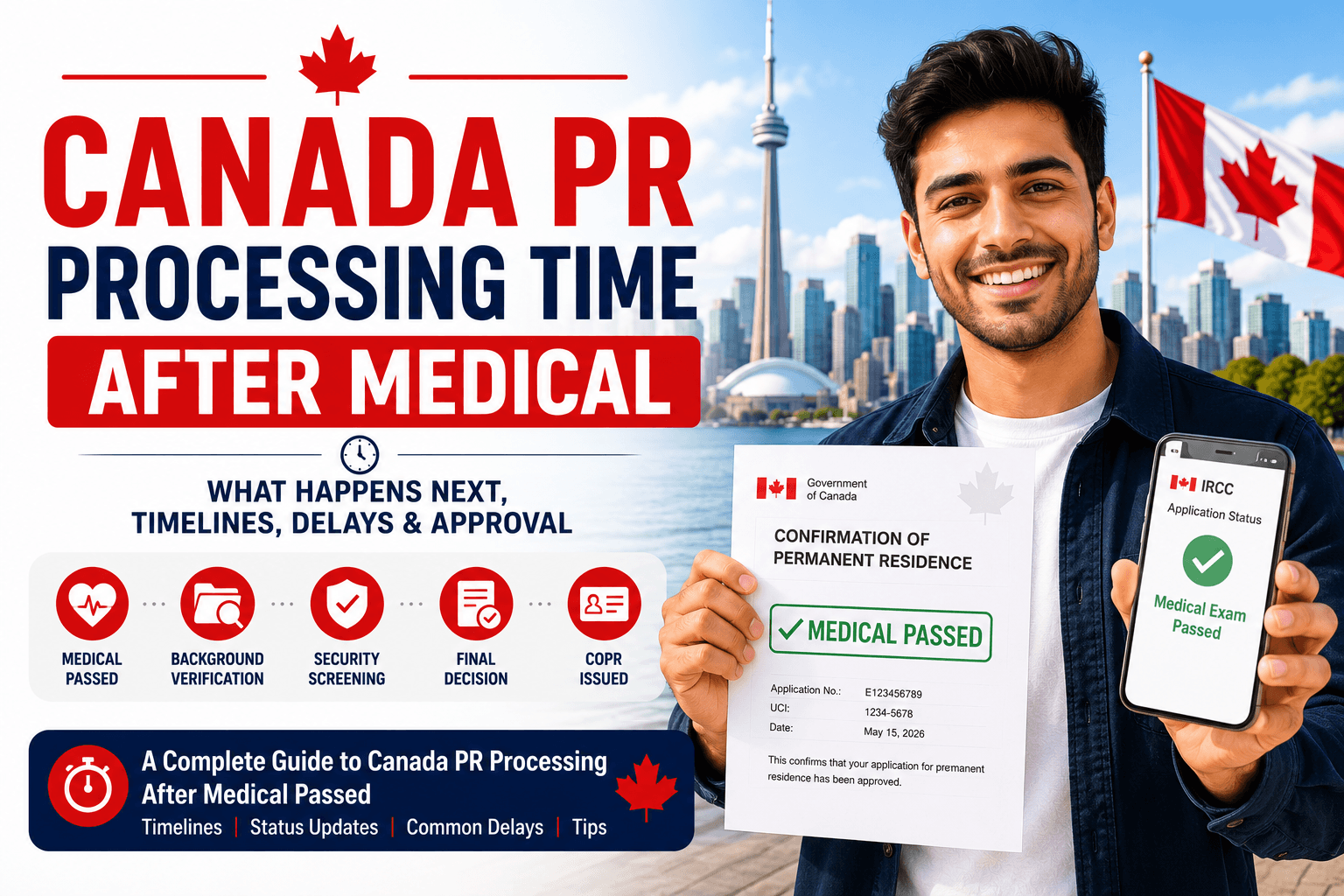
Receiving a “Medical Exam Passed” update in your Immigration, Refugees and Citizenship Canada (IRCC) account is one of the most encouraging milestones in your permanent residence application.
Many applicants believe approval is just around the corner. However, after your medical examination has been accepted, several important assessments may still need to be completed before IRCC can issue a final decision.


One of the most common questions applicants ask is:
“How long does Canada PR take after medical passed?”
The answer depends on several factors, including your immigration program, background verification, security screening, application completeness, and whether IRCC requests additional documents.
While some applicants receive approval relatively soon after passing their medical exam, others may wait considerably longer because every permanent residence application is assessed individually.
This guide explains what happens after your medical examination is passed, the stages that remain, common reasons for delays, and practical tips while waiting for your Canada Permanent Residence decision.
Does Medical Passed Mean My Canada PR Is Approved?
No.
A “Medical Exam Passed” update simply means you’ve met Canada’s immigration health requirements.
It does not mean your permanent residence application has been approved.
Before IRCC issues a Confirmation of Permanent Residence (COPR), several additional assessments may still need to be completed.
Passing your medical examination is an important milestone—but it is not the final step.
What Happens After Medical Passed?
Once your medical results have been accepted, your application generally continues through the remaining stages of processing.
Step 1: Medical Results Accepted
IRCC confirms that your immigration medical examination meets Canada’s health requirements.
If further medical information is needed, IRCC will normally contact you before continuing with your application.
Step 2: Eligibility Review
An immigration officer reviews whether you meet the requirements of the permanent residence program under which you applied.
Depending on your application, the officer may assess:
- Work experience
- Educational qualifications
- Language test results
- Proof of funds (where applicable)
- Provincial nomination (if applicable)
- Employment records
- Supporting documentation
The officer must be satisfied that you meet all program requirements.
Step 3: Background Verification
IRCC reviews information relating to:
- Identity
- Travel history
- Employment history
- Immigration history
- Previous visa applications
- Supporting documents
Applications requiring additional verification may remain under review longer.
Step 4: Security Screening
Every permanent residence applicant undergoes security screening before approval.
This stage is completed internally and cannot be expedited by applicants.
Step 5: Final Officer Review
After all assessments have been completed, an immigration officer performs a final review of the application.
The officer confirms that:
- Eligibility requirements have been met
- Medical requirements have been satisfied
- Background verification has been completed
- Security screening has been completed
- All required documents are present
Step 6: Final Decision
Once the final review has been completed, IRCC issues a decision.
If your application is approved, you’ll normally receive instructions relating to your Confirmation of Permanent Residence (COPR) or permanent resident portal, depending on your circumstances and whether you’re applying from inside or outside Canada.
Factors That Affect Canada PR Processing Time After Medical
Several factors influence how quickly IRCC reaches a final decision after your medical examination has been accepted.
Immigration Program
Processing timelines vary depending on the permanent residence pathway.
Examples include:
- Express Entry
- Provincial Nominee Program (PNP)
- Family Sponsorship
- Atlantic Immigration Program
- Rural and Northern Immigration pathways
Each program follows its own processing workflow.
Application Completeness
Applications containing complete, accurate, and well-organized supporting documents generally move more efficiently through processing.
Missing information may result in additional review.
Background Verification
Travel history, employment records, previous immigration applications, and identity verification can all affect processing times.
Security Screening
Security screening is mandatory for every permanent residence applicant and may take different amounts of time depending on individual circumstances.
Additional Document Requests
If IRCC requests updated information after your medical exam has been passed, processing usually pauses until the requested documents have been received and reviewed.
Application Volume
Processing times can increase during periods when IRCC receives a high number of permanent residence applications.
How to Improve Your Chances of Faster Processing
Although applicants cannot guarantee faster approval, careful preparation can reduce unnecessary delays.
Submit Complete Supporting Documents
Ensure every required document has been uploaded before submitting your application.
Incomplete applications remain one of the leading causes of processing delays.
Keep Your Information Updated
Notify IRCC promptly if there are important changes to your circumstances, such as a new passport, updated contact information, or changes in your family composition.
Monitor Your IRCC Account
Check your online account regularly for messages or document requests.
Responding quickly helps keep your application moving.
Respond Promptly to Additional Requests
If IRCC requests updated police certificates, employment documents, or other information, upload the requested documents as soon as possible.
Prompt responses help reduce avoidable delays.
If you’re applying through Express Entry, our Canada Express Entry Processing Time guide explains the complete process. Applicants may also find our Canada PR Processing Time After Biometrics and Canada Work Permit Processing Time After Medical guides useful for understanding related immigration timelines.
Why Is My Canada PR Application Taking So Long After Medical Passed?
Seeing “Medical Exam Passed” in your IRCC account is a positive sign, but it does not mean your permanent residence application is about to be approved immediately.
After your medical results have been accepted, IRCC may still need to complete several important assessments before issuing a final decision.
A longer wait after your medical examination does not automatically mean your application will be refused.
Below are the most common reasons why Canada PR applications remain under review after the medical stage.
Eligibility Review
One of the final stages after your medical examination is the eligibility assessment.
An immigration officer carefully confirms that you continue to meet the requirements of the immigration program under which you applied.
Depending on your application, IRCC may review:
- Skilled work experience
- Educational qualifications
- Language test results
- Provincial nomination (if applicable)
- Proof of funds
- Employment records
- Supporting documents
The officer must be satisfied that every eligibility requirement has been met before approval can be issued.
Background Verification
Background verification is often one of the longest stages after medical passed.
IRCC may verify:
- Identity
- Employment history
- Travel history
- Previous visa applications
- Immigration records
- Supporting documents
Applicants with extensive travel or employment histories may experience longer verification times.
Security Screening
Every permanent residence applicant undergoes security screening before approval.
This stage is completed by the appropriate Canadian authorities and cannot be expedited by applicants or immigration representatives.
The duration varies depending on individual circumstances.
Additional Document Requests
Sometimes IRCC requests updated information before making a final decision.
Common requests include:
- Updated passport
- New police certificate
- Updated proof of funds
- Additional employment documents
- Marriage or birth certificates
- Schedule A forms
- Other supporting evidence
Processing generally resumes after the requested documents have been received and reviewed.
Application Volume
Canada receives thousands of permanent residence applications throughout the year.
Periods of increased application volume may result in longer processing times across several immigration programs.
How to Avoid Processing Delays
Although no applicant can guarantee faster approval, careful preparation helps reduce avoidable delays.
Submit Complete Supporting Documents
Ensure every required document is accurate, complete, and uploaded before submitting your application.
Incomplete applications remain one of the leading causes of delays.
Keep Your Information Current
Inform IRCC promptly if there are changes to:
- Passport
- Address
- Telephone number
- Email address
- Marital status
- Family composition
Keeping your information updated helps prevent unnecessary interruptions.
Monitor Your IRCC Account
Check your online account regularly for messages and document requests.
Missing an IRCC request can significantly delay processing.
Respond Quickly to Requests
If IRCC asks for additional documents, upload them as soon as possible.
Prompt responses help your application continue moving toward a final decision.
How to Track Your Canada PR Application
You can monitor your permanent residence application through your online IRCC account.
Common status updates include:
- Application submitted
- Biometrics completed
- Medical exam passed
- Eligibility review
- Background verification
- Security screening
- Final decision
It’s completely normal for your account to remain unchanged for several weeks while IRCC completes internal processing.
What Happens After Approval?
If your permanent residence application is approved, IRCC will provide instructions based on whether you’re applying from inside or outside Canada.
Depending on your situation, you may receive:
- Confirmation of Permanent Residence (COPR)
- Permanent Residence Portal invitation
- Passport Request (if applicable)
- Landing instructions
After completing the required steps, you’ll officially become a Canadian permanent resident.
Your Permanent Resident (PR) Card is normally issued after your landing has been completed and your status has been finalized.
Frequently Asked Questions
How long does Canada PR take after medical passed?
The timeline varies depending on your immigration program, background verification, security screening, application volume, and individual circumstances.
Does medical passed mean my PR is approved?
No.
It only means you’ve met Canada’s immigration medical requirements.
IRCC must still complete eligibility review, background verification, security screening, and a final officer assessment.
Why hasn’t my application changed after medical passed?
This is completely normal.
Many permanent residence applications remain under review while IRCC completes internal assessments that are not immediately visible in your online account.
Can I speed up my PR application after medical passed?
Generally, no.
The best way to avoid delays is to submit a complete application and respond promptly to any requests from IRCC.
Will IRCC contact me if more documents are needed?
Yes.
If additional information is required, IRCC will usually send you a message through your online account.
What happens after my PR application is approved?
You’ll receive instructions regarding your Confirmation of Permanent Residence (COPR), PR Confirmation Portal, or any remaining steps required to finalize your permanent resident status.
What is COPR?
The Confirmation of Permanent Residence (COPR) is an official immigration document confirming that your application for Canadian permanent residence has been approved.
What happens after I receive COPR?
Applicants outside Canada normally complete the landing process upon arrival in Canada.
Applicants already inside Canada may complete the process through the Permanent Residence Portal or other IRCC instructions.
Will I receive my PR Card immediately?
No.
The Permanent Resident Card is generally produced after you’ve officially become a permanent resident and completed the required landing process.
Can my family receive PR at the same time?
If eligible family members were included in your application and they meet all requirements, IRCC may process their permanent residence together with yours.
Final Thoughts
Passing your immigration medical examination is an important milestone in the Canada Permanent Residence process, but it isn’t the final step. After your medical results are accepted, IRCC still completes several critical assessments, including eligibility review, background verification, security screening, and a final officer review before issuing a decision.
If your application remains under review after the medical stage, don’t assume something is wrong. Many applications spend several weeks—or longer—in internal processing before approval is granted.
The strongest applications are supported by complete documentation, accurate information, and prompt responses to any IRCC requests. By keeping your information up to date, monitoring your online account regularly, and remaining patient, you’ll be well prepared for the final stage of your journey toward becoming a Canadian permanent resident.