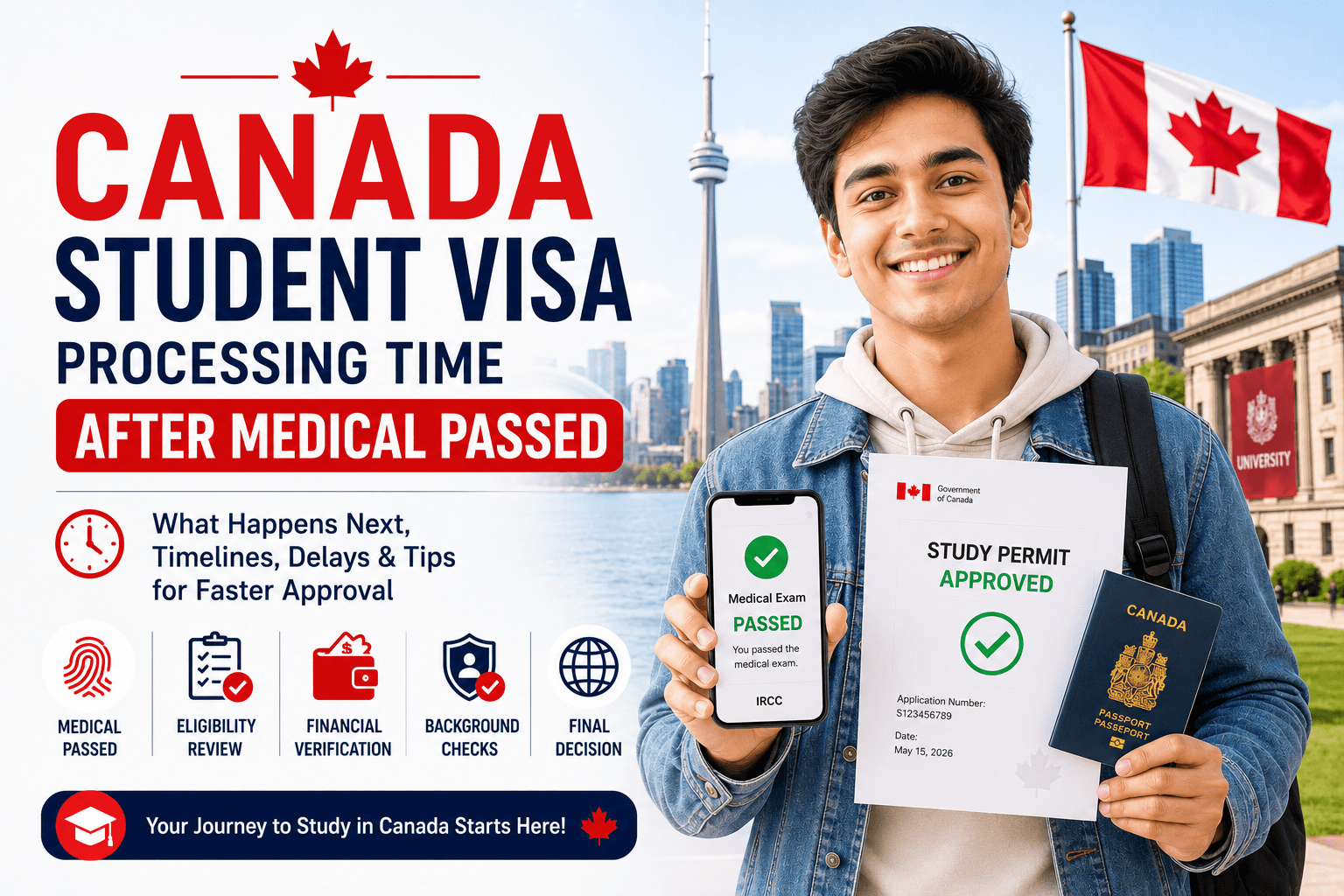
Seeing “You passed the medical exam” in your IRCC account is an exciting moment for many international students. It means you’ve successfully met one of the major health requirements for studying in Canada.
However, many applicants become anxious when they notice that nothing else seems to happen after their medical results are updated.
One of the most common questions students ask is:
“How long does it take to get a Canada Student Visa after medical passed?”
The answer depends on several factors.
Although passing your immigration medical examination is an important milestone, it does not mean your study permit has been approved. Immigration, Refugees and Citizenship Canada (IRCC) must still complete eligibility assessments, financial verification, background checks, security screening, and a final officer review before making a decision.
Some applicants receive approval shortly after their medical results are marked as passed, while others experience longer waiting periods because additional checks or documents are required.
This guide explains what happens after your medical exam is passed, why some applications take longer than others, and what you can do while waiting for your Canada Student Visa decision.
Does Medical Passed Mean My Canada Student Visa Is Approved?
No.
A “Medical Passed” update simply confirms that you’ve satisfied the medical requirements for your application.
Your study permit is not approved until IRCC completes every remaining assessment and issues a final decision.
Passing the medical examination should therefore be viewed as an important step rather than a guarantee of approval.
What Happens After Medical Passed?
Once your medical results have been accepted by IRCC, your application generally moves through several remaining stages.
Step 1: Medical Results Accepted
IRCC confirms that your immigration medical examination satisfies the health requirements for a Canadian study permit.
If additional medical information is required, IRCC will normally contact you before continuing with your application.
Step 2: Eligibility Review
An immigration officer reviews whether you qualify for a Canadian study permit.
The officer may assess:
- Letter of Acceptance (LOA)
- Educational background
- Previous academic history
- Purpose of study
- Study plan
- Immigration history
The officer must be satisfied that your primary purpose for travelling to Canada is to pursue your education.
Step 3: Financial Verification
IRCC reviews whether you have enough financial resources to support yourself during your studies.
Financial evidence may include:
- Bank statements
- Guaranteed Investment Certificate (GIC), where applicable
- Scholarship letters
- Sponsorship documents
- Education loan approval
- Parents’ or sponsors’ financial records
Strong financial documentation can help reduce the need for additional document requests.
Step 4: Background Verification
IRCC may review:
- Identity
- Travel history
- Previous visas
- Immigration records
- Supporting documents
Applications with straightforward histories generally move more efficiently.
Step 5: Security Screening
Every study permit applicant undergoes security screening before a final decision can be made.
This stage is completed internally and cannot be expedited by the applicant.
Step 6: Final Officer Review
Once all assessments have been completed, an immigration officer performs a final review.
The officer confirms that:
- Eligibility requirements have been met
- Financial requirements are satisfied
- Medical requirements have been passed
- Background and security checks have been completed
Step 7: Final Decision
If approved, IRCC issues a decision through your online account.
Applicants who require a Temporary Resident Visa (TRV) will normally receive a Passport Request (PPR).
Applicants who require only an Electronic Travel Authorization (eTA) will receive different travel instructions depending on their nationality.
Factors That Affect Canada Student Visa Processing Time After Medical Passed
Several factors influence how quickly IRCC reaches a final decision after your medical results have been accepted.
Application Completeness
Applications containing complete, accurate, and well-organized documents generally move through processing more smoothly.
Financial Evidence
IRCC carefully reviews your financial documents to ensure you can pay for tuition, living expenses, and other educational costs while studying in Canada.
Background Verification
Travel history, previous immigration records, identity verification, and supporting documentation may all require additional review.
Security Screening
Security screening is mandatory for every applicant and may require different amounts of time depending on individual circumstances.
Additional Document Requests
If IRCC requests further information after your medical results have been accepted, processing usually pauses until the requested documents have been reviewed.
Seasonal Application Volume
Study permit applications increase significantly before Canada’s:
- Fall intake
- Winter intake
- Spring intake
Submitting your application well in advance of your intended start date can help reduce the impact of seasonal demand.
How to Improve Your Chances of Faster Processing
Although applicants cannot guarantee faster approval, careful preparation can reduce avoidable delays.
Submit Complete Supporting Documents
Ensure every required document has been uploaded before submitting your application.
Incomplete applications remain one of the leading causes of delays.
Provide Strong Financial Evidence
Clear and consistent financial documentation helps IRCC assess your ability to study and live in Canada without financial difficulty.
Monitor Your IRCC Account Regularly
Check your online account frequently for updates or requests from IRCC.
Respond Quickly to Additional Requests
If IRCC asks for additional documents or clarification, upload the requested information as soon as possible.
Quick responses help your application continue moving through the remaining stages.
If you’ve recently completed biometrics, our Canada Study Permit Processing Time After Biometrics guide explains the earlier stages of the application. You may also find our Canada Study Permit Processing Time guide useful for understanding the complete process from application submission to final approval.
Why Is My Canada Student Visa Taking So Long After Medical Passed?
Seeing “Medical Exam Passed” in your IRCC account is encouraging, but it’s not the final stage of your study permit application.
After your medical results have been accepted, IRCC may still need to complete several internal assessments before issuing a final decision.
A longer wait after your medical exam is passed does not automatically mean your application will be refused.
Below are the most common reasons why a Canada Student Visa may still take time after the medical stage.
Eligibility Review
One of the most important stages after your medical exam is the eligibility assessment.
An immigration officer carefully reviews whether you qualify for a Canadian study permit.
The officer typically assesses:
- Letter of Acceptance (LOA)
- Academic qualifications
- Previous education
- Purpose of study
- Study plan
- Future career goals
- Immigration history
The officer must be satisfied that your primary purpose for travelling to Canada is to study.
Financial Verification
IRCC carefully examines whether you have enough money to support yourself during your studies.
Financial documents commonly reviewed include:
- Bank statements
- Guaranteed Investment Certificate (GIC), where applicable
- Scholarship letters
- Education loan approvals
- Sponsorship documents
- Parents’ or sponsors’ financial records
If your financial information is inconsistent or incomplete, processing may take longer.
Background Verification
IRCC may verify information relating to:
- Identity
- Travel history
- Previous visa applications
- Immigration records
- Supporting documents
Straightforward applications generally move more efficiently than those requiring additional verification.
Security Screening
Every study permit applicant undergoes security screening before approval.
This stage is completed internally by Canadian authorities and cannot be expedited by applicants or representatives.
Additional Document Requests
IRCC may request further information before making a final decision.
Common requests include:
- Updated bank statements
- Revised Letter of Acceptance
- Passport copy
- Additional financial evidence
- Educational transcripts
- Sponsorship documents
- Updated medical information
Processing normally resumes once the requested documents have been received and reviewed.
High Application Volume
Study permit applications increase significantly before Canada’s major academic intakes.
Higher demand is common before:
- Fall intake
- Winter intake
- Spring intake
During these periods, applications may remain under review for longer because of increased workloads.
How to Avoid Processing Delays
Although some delays are beyond your control, careful preparation can reduce unnecessary waiting.
Submit Complete Supporting Documents
Upload every required document before submitting your application.
Incomplete applications remain one of the leading causes of delays.
Provide Strong Financial Evidence
Your financial documents should clearly demonstrate that you can pay for:
- Tuition fees
- Living expenses
- Accommodation
- Return transportation
Recent, genuine, and consistent financial records strengthen your application.
Monitor Your IRCC Account
Check your online account regularly for new messages or document requests.
Missing a request from IRCC can significantly delay your application.
Respond Quickly to Requests
If IRCC asks for additional information, upload the requested documents as soon as possible.
Prompt responses help your application continue moving through the remaining stages.
How to Track Your Canada Student Visa Application
You can monitor your application through your online IRCC account.
Common status updates include:
- Application submitted
- Biometrics completed
- Medical exam passed
- Eligibility review
- Background verification
- Final decision
- Passport Request (if approved)
It’s common for your account to remain unchanged for several weeks while IRCC completes internal reviews.
What Happens After Approval?
If your study permit application is approved and you require a Temporary Resident Visa (TRV), IRCC will send you a Passport Request (PPR).
You’ll submit your passport through your Visa Application Centre for visa stamping.
After the visa has been printed and quality checks have been completed, your passport will be returned.
When travelling to Canada, you’ll normally present:
- Passport
- Port of Entry Letter of Introduction
- Letter of Acceptance
- Proof of financial support
- Any additional documents requested by the border officer
If all entry requirements are met, a Canada Border Services Agency (CBSA) officer will issue your official study permit at the port of entry.
Frequently Asked Questions
How long does it take to get a Canada Student Visa after medical passed?
The timeline varies depending on your country of application, background verification, security screening, application volume, and individual circumstances.
Does medical passed mean my study permit is approved?
No.
It only means you’ve satisfied the medical requirements.
IRCC must still complete eligibility assessment, financial verification, background checks, security screening, and a final officer review.
Why hasn’t my application changed after medical passed?
This is completely normal.
Many applications remain under review while IRCC completes internal assessments that aren’t immediately reflected in your online account.
Can I speed up my study permit after medical passed?
Generally, no.
The best way to avoid delays is to submit a complete application and respond promptly to any requests from IRCC.
Will IRCC contact me if additional documents are needed?
Yes.
If further information is required, IRCC will normally notify you through your online account.
What happens after Passport Request?
You’ll submit your passport for visa stamping.
After the visa has been printed and final quality checks have been completed, your passport will be returned.
Can I book my flight before receiving my visa?
It’s generally recommended that you wait until your passport has been returned with your visa before purchasing non-refundable airline tickets.
Can I work while studying in Canada?
Many international students are allowed to work under the conditions printed on their study permit. Review those conditions carefully after arriving in Canada.
Can my spouse accompany me?
Depending on your circumstances, your spouse or common-law partner may qualify for an open work permit, while your dependent children may also be be eligible to accompany you.
What happens when I arrive in Canada?
A border services officer will review your documents and, if you meet all entry requirements, issue your official study permit at the port of entry.
Final Thoughts
Passing your immigration medical examination is a significant milestone, but it isn’t the final step in obtaining a Canada Student Visa. After your medical results are accepted, IRCC still completes several important assessments, including eligibility review, financial verification, background checks, security screening, and a final officer review.
If your application remains under review after your medical exam has been marked as passed, don’t assume something is wrong. Many applications spend time in internal processing before a final decision is issued.
The strongest applications are those supported by complete documentation, solid financial evidence, a genuine study plan, and timely responses to IRCC requests. By monitoring your online account regularly and remaining patient, you’ll be well prepared for the final stage of the process and your journey to study in Canada.