Canada continues to be one of the most attractive destinations for skilled professionals from India. Every year, thousands of Indian citizens apply for Canadian work permits to take advantage of better career opportunities, competitive salaries, and a high quality of life.
Whether you’ve secured a job offer from a Canadian employer or you’re applying through another eligible work permit pathway, understanding the expected processing time can help you plan your relocation more effectively.


One of the most common questions applicants ask is:
“How long does a Canada Work Permit take from India?”
The answer depends on several factors.
Immigration, Refugees and Citizenship Canada (IRCC) publishes estimated processing times for work permit applications, but these estimates can change depending on application volume, the type of work permit, biometrics, medical examinations, and background verification.
Some applicants receive decisions relatively quickly, while others experience longer waiting periods because additional checks are required.
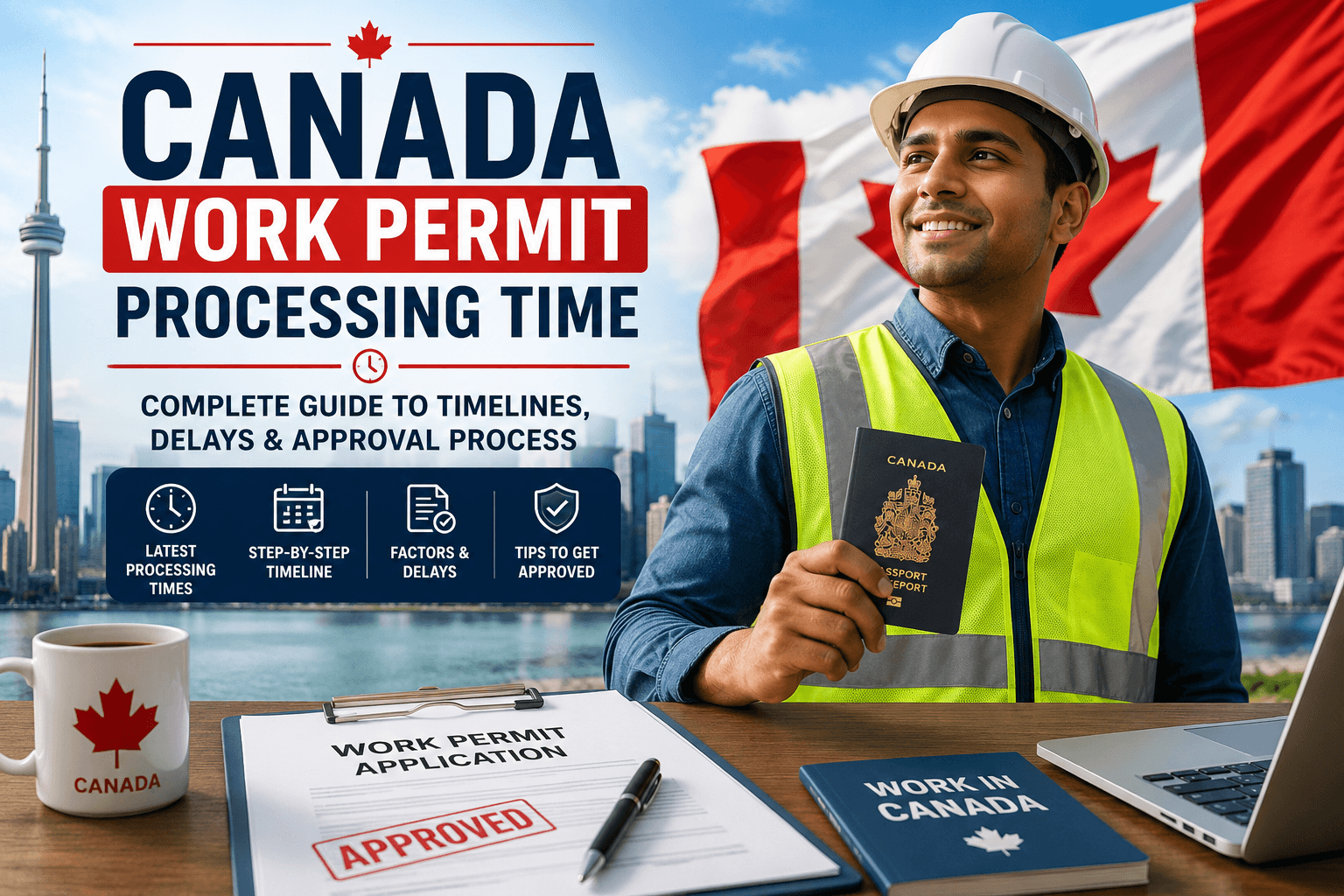
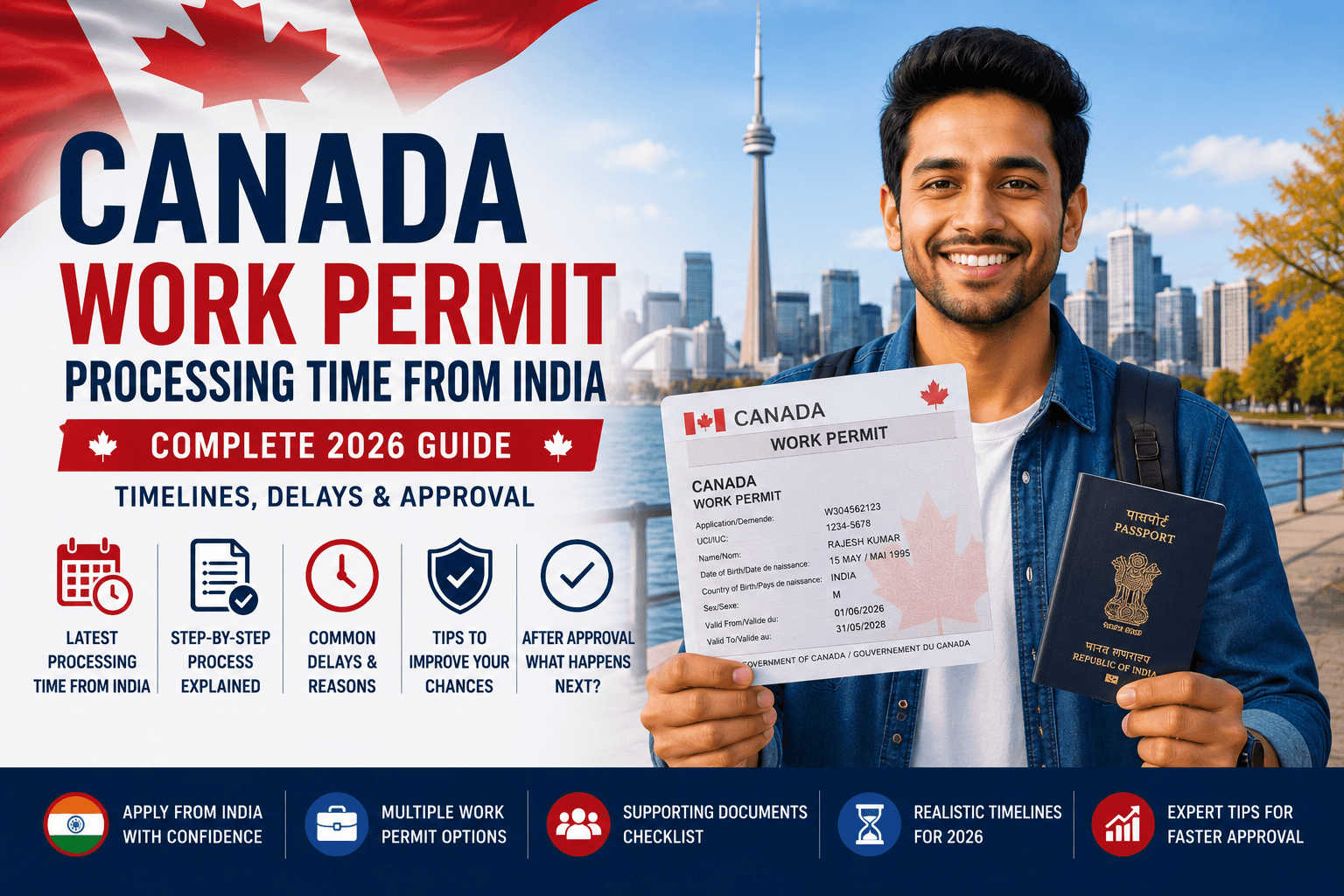
This guide explains the Canada Work Permit processing timeline from India, what affects approval, common reasons for delays, and practical tips for submitting a stronger application.
Do Indian Citizens Need a Work Permit to Work in Canada?
Yes.
Most Indian citizens require a valid Canadian work permit before they can legally work in Canada.
The type of work permit required depends on your circumstances.
Common options include:
- Employer-specific work permit
- Open work permit
- Post-Graduation Work Permit (PGWP)
- Bridging Open Work Permit
- Spousal Open Work Permit
Each category has different eligibility requirements and processing procedures.
Current Canada Work Permit Processing Time from India
The time required to process a work permit application varies depending on several factors, including:
- Type of work permit
- Application volume
- Biometrics
- Medical examination requirements
- Background verification
- Security screening
- Additional document requests
Because IRCC updates its processing estimates regularly, applicants should always check the official processing time tool before making travel arrangements or resigning from their current employment.
How the Canada Work Permit Process Works
Understanding each stage helps you prepare a stronger application and set realistic expectations.
Step 1: Obtain a Job Offer (If Required)
Many work permits require a genuine job offer from a Canadian employer.
Depending on the work permit category, the employer may also need to obtain a Labour Market Impact Assessment (LMIA).
Some work permit categories are LMIA-exempt.
Step 2: Prepare Your Supporting Documents
Before applying, gather every required document.
Typical documents include:
- Valid passport
- Job offer letter
- LMIA (if required)
- Educational certificates
- Employment reference letters
- Resume or CV
- Police certificates (where applicable)
- Medical examination confirmation (if required)
Submitting complete documents from the beginning reduces the risk of delays.
Step 3: Submit Your Online Application
Create an IRCC account, complete the online application, upload your supporting documents, and pay the required government fees.
Double-check every detail before submission.
Small mistakes or inconsistencies can result in additional review.
Step 4: Complete Biometrics
Most applicants from India are required to provide biometrics after submitting their application.
At your Visa Application Centre, you’ll provide:
- Fingerprints
- Digital photograph
Biometrics confirm your identity and allow IRCC to continue processing your application.
However, biometrics do not indicate that your work permit has been approved.
If you’ve already completed this stage, our Canada Work Permit Processing Time After Biometrics guide explains exactly what happens next.
Step 5: Medical Examination
Depending on the type of work you’ll perform in Canada, you may need an immigration medical examination.
Medical examinations are commonly required for applicants planning to work in:
- Healthcare
- Childcare
- Agriculture
- Other designated occupations
If additional medical information is required, processing may take longer.
Step 6: Background Verification
IRCC reviews information relating to:
- Identity
- Employment history
- Immigration history
- Travel history
- Supporting documents
Applicants with straightforward immigration histories generally experience smoother processing.
Step 7: Security Screening
Every work permit applicant undergoes security screening before a final decision is made.
Applicants cannot influence or speed up this stage.
Step 8: Final Decision
Once all assessments have been completed, IRCC issues a final decision.
If approved, you’ll receive instructions regarding the next steps before travelling to Canada.
For many applicants outside Canada, this includes receiving a Port of Entry Letter of Introduction, which you’ll present to a border services officer upon arrival.
Factors That Affect Canada Work Permit Processing Time from India
Several factors influence how long your application takes.
Type of Work Permit
Open work permits, employer-specific work permits, and LMIA-exempt permits all follow different processing procedures.
Some categories naturally require more verification than others.
Labour Market Impact Assessment (LMIA)
Where an LMIA is required, both the employer’s application and your work permit application can affect the overall timeline.
Medical Examination Requirements
Applicants who require immigration medical examinations often experience longer processing times than those who do not.
Background Verification
Employment history, previous visas, immigration records, and identity documents may all require verification.
Additional Document Requests
If IRCC requests further documentation after submission, processing usually pauses until the requested information has been reviewed.
Seasonal Application Volume
Application numbers often increase during:
- International recruitment campaigns
- Canadian hiring seasons
- University graduation periods
- Seasonal employment programs
Higher demand can result in longer waiting times.
How to Improve Your Chances of Faster Processing
Although no applicant can guarantee quicker approval, careful preparation can reduce avoidable delays.
Submit Complete Documentation
Ensure every required document has been uploaded before submitting your application.
Missing documents remain one of the most common causes of processing delays.
Review Your Application Carefully
Before clicking “Submit,” verify:
- Passport details
- Employment information
- Job offer details
- Personal information
- Uploaded documents
Consistency throughout your application is essential.
Complete Your Medical Examination Promptly
If a medical examination is required, complete it as early as possible to avoid unnecessary delays later in the process.
Respond Quickly to IRCC Requests
If IRCC requests additional documents or clarification, upload the requested information as soon as possible.
Prompt responses help keep your application moving.
If you’re still deciding which type of Canadian work authorization is right for you, our Canada Work Permit Processing Time guide explains the overall work permit process, while our Canada Open Work Permit Processing Time article covers applicants who aren’t tied to a single employer.
Canada Work Permit Processing Time After Biometrics for Indian Applicants
Completing your biometrics appointment is a major milestone in your Canadian work permit application. Once you’ve provided your fingerprints and photograph at a Visa Application Centre (VAC), Immigration, Refugees and Citizenship Canada (IRCC) can begin the remaining stages of processing.
Many applicants assume that a decision will arrive shortly after biometrics. However, biometrics simply verify your identity and allow IRCC to continue assessing your application.
Several important reviews still take place before a final decision is made.
After biometrics, your application generally progresses through these stages:
- Eligibility assessment
- Employer and job offer verification (where applicable)
- Medical examination review
- Background verification
- Security screening
- Final officer review
- Decision
Applicants who completed biometrics on the same day may receive their decisions weeks apart because every application is assessed individually.
If you’re interested in a more detailed explanation of this stage, our Canada Work Permit Processing Time After Biometrics guide explains what IRCC reviews after receiving your biometrics.
Why Is My Canada Work Permit Taking So Long from India?
Waiting for your work permit can be stressful, especially if you’ve already received a job offer and your employer is expecting you to start work.
Fortunately, a longer processing time does not necessarily indicate that there’s a problem with your application.
Several factors commonly contribute to delays.
Employer Verification
For employer-specific work permits, IRCC may verify:
- Job offer details
- Employer information
- LMIA (if applicable)
- Wage information
- Employment conditions
If additional clarification is needed, processing may take longer.
Medical Examination Review
Applicants intending to work in certain occupations may require an immigration medical examination.
Examples include:
- Healthcare
- Childcare
- Agriculture
- Long-term care
- Other designated occupations
If additional medical information is requested, your application may remain under review until the assessment is complete.
Background Verification
IRCC reviews:
- Immigration history
- Employment history
- Previous visas
- Identity documents
- Travel history
Straightforward applications generally move through this stage more quickly.
Security Screening
Every work permit applicant undergoes security screening before approval.
Applicants cannot influence this process or request faster security screening.
Additional Document Requests
IRCC may request further information before making a decision.
Common requests include:
- Updated passport
- Revised employment letter
- New LMIA documents
- Additional financial evidence
- Updated police certificate
- Identity clarification
Processing usually pauses until the requested documents have been received and reviewed.
High Application Volume
Canada receives a significant number of work permit applications from India each year.
During periods of increased international recruitment or seasonal hiring, processing centres may experience higher workloads, which can extend waiting times.
How to Avoid Canada Work Permit Processing Delays
Although some delays are beyond your control, careful preparation can significantly improve your application.
Apply Early
Submit your application well before your intended travel date.
This provides additional time if IRCC requests more documents.
Upload Complete Supporting Documents
Before submitting your application, ensure you’ve included every required document.
Typical documents include:
- Passport
- Job offer letter
- LMIA (if applicable)
- Educational certificates
- Employment reference letters
- Resume or CV
- Medical examination confirmation (if required)
Ensure Your Job Offer Is Accurate
Check that your employer has provided accurate information regarding:
- Position
- Salary
- Work location
- LMIA details (if applicable)
Even minor inconsistencies may require additional review.
Respond Quickly to IRCC Requests
If IRCC contacts you for further information, upload the requested documents as soon as possible.
Prompt responses help reduce avoidable delays.
How to Track Your Canada Work Permit Application
You can monitor your application through your online IRCC account.
Common application updates include:
- Application submitted
- Biometrics requested
- Biometrics completed
- Medical examination passed
- Eligibility review
- Background verification
- Final decision
It is completely normal for your status to remain unchanged for several weeks while IRCC completes internal assessments.
What Happens After Approval?
If your work permit application is approved, IRCC will issue a Port of Entry (POE) Letter of Introduction for most applicants applying from outside Canada.
This letter is not your work permit.
Instead, you’ll present it to a border services officer when you arrive in Canada.
The officer will then issue your actual work permit if all entry requirements are met.
Before travelling, carefully verify:
- Your name
- Passport number
- Employer details (if applicable)
- Validity dates
- Personal information
If you notice any errors, contact IRCC before travelling.
Frequently Asked Questions
How long does a Canada Work Permit take from India?
Processing times vary depending on the type of work permit, application volume, medical examinations, and background checks.
Does biometrics mean my work permit is approved?
No.
Biometrics only verify your identity.
IRCC must still complete eligibility assessment, employer verification, medical review, background checks, security screening, and a final officer review.
Can I travel to Canada while my work permit is being processed?
Generally, you should wait until you receive your approval and the appropriate travel documents before making travel arrangements.
Can I change employers after applying?
If you’ve applied for an employer-specific work permit, changing employers may require a new application or an amendment, depending on your circumstances.
Can I speed up my work permit application?
IRCC does not normally offer expedited processing for standard work permit applications.
Submitting a complete and accurate application remains the best way to avoid delays.
Will IRCC contact me if additional documents are needed?
Yes.
If further information is required, IRCC will normally notify you through your online account or by email.
What is a Port of Entry Letter of Introduction?
It is an approval letter issued to many applicants outside Canada after their work permit application is approved.
You’ll present this letter to a border services officer when entering Canada to receive your work permit.
Can my spouse apply with me?
Depending on your eligibility, your spouse may qualify for an open work permit. Our Canada Open Work Permit Processing Time guide explains this pathway in greater detail.
Can this work permit lead to permanent residence?
Yes.
Many foreign workers later become eligible for permanent residence through programs such as Canada Express Entry Processing Time or various Provincial Nominee Programs.
Final Thoughts
Canada remains one of the most attractive destinations for skilled professionals from India, offering strong employment opportunities and multiple pathways to permanent residence. While work permit processing times vary depending on your application type and individual circumstances, careful preparation can significantly improve your chances of a smooth experience.
The strongest applications include complete supporting documents, accurate employment information, and prompt responses to any requests from IRCC. After biometrics, remember that your application still undergoes several important stages, including employer verification, medical review, background checks, and security screening.
Avoid comparing your timeline with those of other applicants, as every case is unique. Continue monitoring your IRCC account regularly, keep your documents current, and be ready to provide additional information if requested. With patience and a well-prepared application, you’ll be in a strong position to receive your approval and begin your career in Canada.