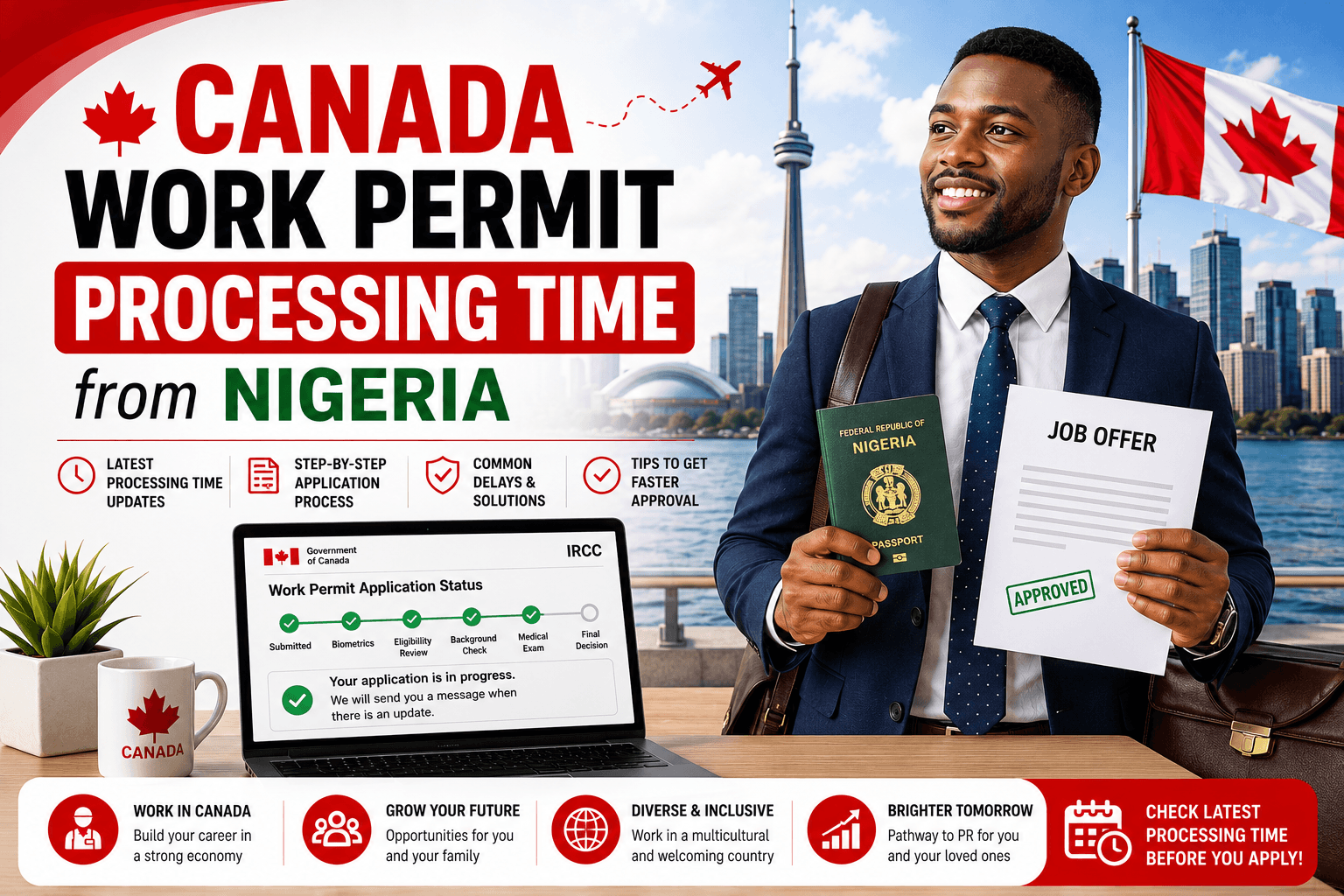
Canada remains one of the most attractive destinations for skilled workers from Nigeria because of its strong economy, competitive salaries, excellent quality of life, and opportunities to build a long-term career.
If you’ve secured a Canadian job offer or are planning to apply for a work permit, one of the first questions you’ll likely ask is:


“How long does a Canada Work Permit take to process from Nigeria?”
The answer depends on several factors, including the type of work permit you’re applying for, the completeness of your application, biometrics, medical examination requirements, background verification, security screening, and Immigration, Refugees and Citizenship Canada (IRCC)’s current workload.
Some applicants receive decisions relatively quickly, while others may experience longer waiting periods if additional reviews are required.
This guide explains the complete Canada Work Permit application process for applicants in Nigeria, what happens after you apply, factors that affect processing times, and practical steps you can take to reduce unnecessary delays.
What Is a Canada Work Permit?
A Canada Work Permit is an official document issued by IRCC that authorizes eligible foreign nationals to work legally in Canada for a specified employer or, in some cases, for any eligible employer.
Depending on your situation, you may qualify for:
- Employer-specific work permit
- Open work permit
- Post-Graduation Work Permit (PGWP)
- Spousal open work permit
- Other specialized work permit programs
The type of work permit you apply for can influence both the application requirements and the processing timeline.
Who Can Apply from Nigeria?
Nigerian citizens who meet Canada’s immigration requirements may apply for a work permit if they qualify under an eligible program.
Depending on the permit type, applicants may need:
- A valid job offer
- A Labour Market Impact Assessment (LMIA), where required
- A valid passport
- Proof of qualifications or work experience
- Financial evidence (where applicable)
- Any additional documents requested by IRCC
Meeting all eligibility requirements before applying helps reduce the likelihood of delays.
Canada Work Permit Application Process from Nigeria
Understanding each stage of the application process helps you know what to expect after submitting your application.
Step 1: Confirm Your Eligibility
Before applying, ensure you qualify for the work permit category that matches your situation.
Review the eligibility requirements carefully and gather all necessary documents.
Step 2: Prepare Your Supporting Documents
Most applicants from Nigeria prepare documents such as:
- Valid passport
- Job offer letter (if applicable)
- LMIA (where required)
- Employment contract
- Educational certificates
- Professional qualifications
- Proof of work experience
- Passport photographs
- Additional supporting documents requested by IRCC
Submitting complete documentation helps prevent unnecessary delays.
Step 3: Submit Your Online Application
Most applicants submit their work permit application online through the IRCC portal.
You’ll complete the required forms, upload supporting documents, and pay the applicable processing fees.
Step 4: Complete Biometrics
After your application is received, IRCC usually issues a Biometrics Instruction Letter (BIL).
You’ll then schedule an appointment at an authorized Visa Application Centre (VAC) in Nigeria to provide:
- Fingerprints
- Digital photograph
Biometrics help IRCC verify your identity and are a standard part of the application process.
Step 5: Eligibility Review
An immigration officer reviews your application to determine whether you meet the requirements for the work permit you’ve applied for.
The officer may assess:
- Job offer
- Employment documents
- Qualifications
- Work experience
- Financial information (where applicable)
- Supporting documents
Step 6: Background Verification
IRCC verifies information submitted in your application.
This may include reviewing:
- Identity
- Immigration history
- Previous visa applications
- Travel history
- Employment records
- Supporting documents
Some applications require more detailed verification than others.
Step 7: Medical Examination
Some applicants are required to complete an immigration medical examination, particularly if their occupation or travel history requires it.
IRCC reviews the medical results before moving to the next stage.
If additional medical information is required, processing may take longer.
Step 8: Security Screening
Every work permit application undergoes an appropriate level of security screening before a final decision is made.
This stage is completed internally by IRCC.
Step 9: Final Decision
Once all required assessments have been completed, IRCC makes a final decision.
If your application is approved, you’ll usually receive a Passport Request (PPR) if your passport has not already been submitted.
Step 10: Passport Submission and Visa Issuance
After receiving the Passport Request, you’ll submit your passport through the Visa Application Centre.
IRCC places the required visa in your passport before returning it so you can travel to Canada and begin working.
Factors That Affect Processing Time
Several factors influence how long a Canada Work Permit application from Nigeria may take.
Application Completeness
Applications containing complete and accurate documentation generally move through processing more efficiently.
Employment Verification
IRCC may verify your job offer, employer information, employment history, or supporting documents.
Additional verification may extend processing.
Background Verification
Identity, immigration history, and travel history checks may affect overall processing time.
Medical Examination
If additional medical tests are required, the application may remain under review until IRCC receives all necessary results.
Seasonal Demand
Applications often increase during periods of high immigration demand, which can result in longer processing times.
How to Reduce Delays
Although applicants cannot control IRCC’s internal processing, you can reduce avoidable delays by:
- Submitting a complete application.
- Uploading clear and readable documents.
- Providing accurate employment information.
- Completing biometrics promptly.
- Completing your medical examination quickly if requested.
- Responding immediately to IRCC requests.
- Monitoring your IRCC account regularly.
If you’re following other stages of your immigration process, you may also find our guides on Canada Work Permit Processing Time After Medical, Canada Study Permit Processing Time from Nigeria, Canada Visitor Visa Processing Time from Nigeria, and IRCC Visitor Visa Processing Time Explained helpful.
Why Is My Canada Work Permit Taking Longer Than Expected?
Many applicants from Nigeria become concerned when their Canada Work Permit application takes longer than expected.
In most cases, a longer processing time does not mean your application will be refused.
Every work permit application is assessed individually, and some require additional verification before Immigration, Refugees and Citizenship Canada (IRCC) can make a final decision.
Below are the most common reasons why Canada Work Permit applications from Nigeria may experience delays.
Incomplete Application
One of the most common reasons for delays is submitting an incomplete application.
Examples include:
- Missing supporting documents
- Incomplete application forms
- Poor-quality document scans
- Missing employment documents
- Missing LMIA (if required)
- Inconsistent information
Before submitting your application, carefully review every document to ensure it is complete, accurate, and easy to read.
Employment Verification
IRCC may verify information relating to your employment.
This can include:
- Job offer letter
- Employer details
- Labour Market Impact Assessment (LMIA), if required
- Employment contract
- Work experience
- Professional qualifications
If additional verification is required, processing may take longer.
Background Verification
IRCC may review:
- Identity
- Immigration history
- Previous visa applications
- Travel history
- Employment records
- Supporting documents
Applicants with extensive travel or previous immigration applications may require additional review.
Medical Examination
Some work permit applicants are required to complete an immigration medical examination.
Processing may take longer if:
- Medical results have not been received.
- Additional medical tests are requested.
- IRCC requires further medical clarification.
Completing your medical examination promptly can help reduce avoidable delays.
Security Screening
Every work permit application undergoes security screening before a final decision is made.
This process is completed internally by IRCC and cannot usually be expedited.
Additional Document Requests
IRCC may request additional documents during processing.
Examples include:
- Updated passport
- Employment confirmation
- Revised job offer
- Additional proof of qualifications
- Police certificates (if requested)
- Additional identity documents
Processing usually continues after the requested documents have been reviewed.
High Application Volume
Canada receives thousands of work permit applications throughout the year.
Processing times may increase during periods of high demand as IRCC manages larger application volumes.
What Should You Do While Waiting?
Although you cannot speed up IRCC’s internal review process, there are several practical steps you can take while waiting.
Monitor Your IRCC Account
Check your account regularly for updates such as:
- Biometrics completed
- Eligibility review
- Background verification
- Medical results
- Passport Request (PPR)
- Final decision
Some stages may remain unchanged for several weeks while internal reviews continue.
Respond Quickly to IRCC Requests
If IRCC requests additional documents, upload them as soon as possible.
Prompt responses help prevent unnecessary delays.
Keep Your Documents Up to Date
If your passport or other important documents expire while your application is being processed, follow IRCC’s instructions for submitting updated information.
Avoid Duplicate Applications
Submitting another work permit application while one is already in progress usually does not speed up processing and may complicate your case.
What Happens After Approval?
If your work permit application is approved, IRCC will usually issue a Passport Request (PPR) if your passport has not already been submitted.
The remaining process generally includes:
- Submit your passport through the Visa Application Centre (VAC).
- IRCC places the visa in your passport.
- Your passport is returned through the VAC or courier service.
- You prepare to travel to Canada.
Before travelling, carefully verify:
- Your full name
- Passport number
- Visa validity dates
- Number of entries
If you notice any errors, contact the Visa Application Centre immediately.
Frequently Asked Questions
How long does a Canada Work Permit take from Nigeria?
Processing times vary depending on the work permit category, background verification, medical examination, security screening, and IRCC’s current workload.
Does biometrics mean my work permit is approved?
No.
Biometrics are used to verify your identity. Your application must still pass eligibility, background, medical, and security assessments.
Why is my work permit taking so long?
Common reasons include:
- Employment verification
- Background checks
- Medical examination
- Security screening
- Additional document requests
- High application volume
Can I speed up my work permit application?
Generally, no.
The best way to reduce delays is to submit a complete application, provide accurate supporting documents, and respond quickly to IRCC requests.
What happens after Passport Request?
You’ll submit your passport through the Visa Application Centre, after which IRCC will place the required visa in your passport before returning it.
Can I travel before receiving my passport?
No.
You should wait until your passport has been returned with your visa before making travel arrangements.
Can my family accompany me to Canada?
Depending on your circumstances and the type of work permit you hold, your spouse or common-law partner and dependent children may be eligible to apply to accompany you. Each family member must meet the applicable immigration requirements.
What if my work permit application is refused?
IRCC normally provides a refusal letter explaining the reasons.
You may submit a new application after addressing the issues identified in the refusal.
What are the most common reasons for refusal?
Common reasons include:
- Incomplete documentation
- Weak supporting evidence
- Questions about the job offer
- Insufficient proof of qualifications
- Inconsistent information
- Failure to meet eligibility requirements
Can I change employers after receiving my work permit?
It depends on the type of work permit you receive. An employer-specific work permit usually limits you to the employer named on the permit, while an open work permit generally provides greater flexibility.
Final Thoughts
Canada offers excellent employment opportunities for qualified workers from Nigeria, but obtaining a work permit requires careful preparation and patience. Every application goes through multiple stages, including eligibility review, background verification, medical assessment where required, security screening, and a final decision by IRCC.
To improve your chances of a smooth application, submit complete and accurate documents, provide clear employment evidence, complete your biometrics and medical examination promptly, and respond quickly to any IRCC requests. Careful preparation and regular monitoring of your application can help you navigate the process with greater confidence and move one step closer to starting your career in Canada.