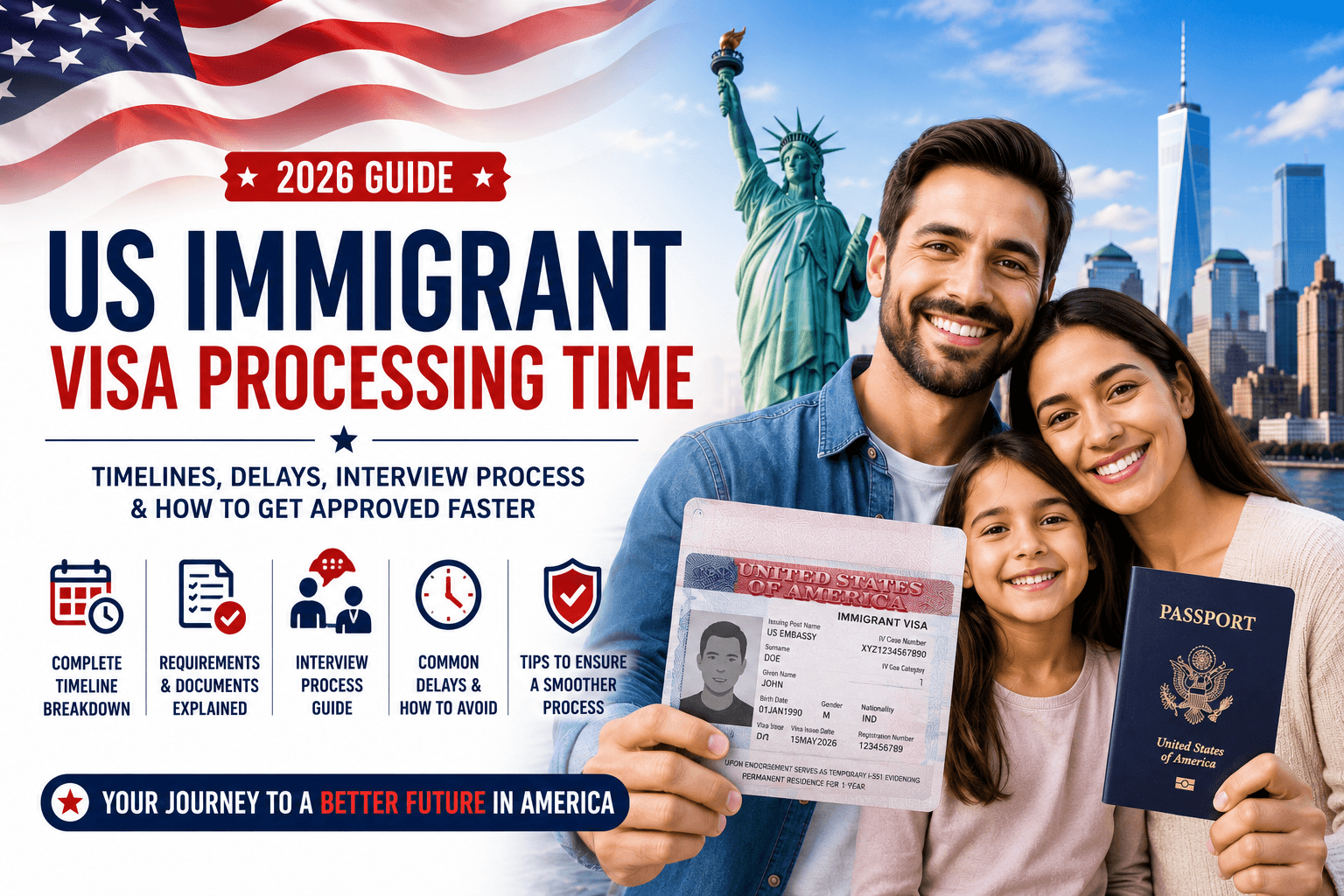
Receiving approval for a United States immigrant visa is one of the most important milestones for people planning to live permanently in America. Whether you’re immigrating through a family member, an employer, or another eligible immigration category, understanding the processing timeline can help you prepare for every stage of the journey.
One of the most common questions applicants ask is:
“How long does a US immigrant visa take to process?”
The answer depends on several factors.
Unlike temporary visitor or work visas, immigrant visa applications involve multiple government agencies, extensive document verification, background checks, medical examinations, and an interview before a final decision is made.
Some applicants receive their immigrant visas relatively quickly, while others wait much longer because of visa availability, annual quotas, country-specific backlogs, or requests for additional documentation.
Understanding each stage of the process can help reduce uncertainty and improve your overall preparation.
This guide explains how US immigrant visa processing works, what affects timelines, common reasons for delays, and practical tips to improve your chances of a successful application.
What Is a US Immigrant Visa?
A US immigrant visa allows eligible foreign nationals to enter the United States as lawful permanent residents.
After entering the United States using an immigrant visa, eligible applicants generally receive their Permanent Resident Card (Green Card).
Immigrant visas are commonly issued through:
- Family-sponsored immigration
- Employment-based immigration
- Diversity Visa (DV) Program
- Special immigrant categories
- Certain humanitarian programs
Each immigration pathway follows different eligibility requirements and may have different processing timelines.
How Long Does US Immigrant Visa Processing Take?
The overall timeline depends on several stages.
These include:
- Petition approval
- National Visa Center (NVC) processing
- Visa availability
- Document submission
- Medical examination
- Consular interview
- Administrative processing (if required)
- Passport return with immigrant visa
The total processing time varies depending on the immigration category and your individual circumstances.
How the US Immigrant Visa Process Works
Understanding every stage helps applicants prepare realistic expectations.
Step 1: Petition Approval
Many immigrant visa categories begin with a petition filed by:
- A qualifying family member
- A US employer
- Another eligible petitioner
The petition is reviewed by the appropriate US immigration authorities before the immigrant visa process continues.
Petition approval does not automatically mean an immigrant visa is immediately available.
Step 2: National Visa Center (NVC) Processing
After petition approval, eligible cases are transferred to the National Visa Center (NVC).
The NVC is responsible for preparing immigrant visa cases before they are scheduled for interview at a US embassy or consulate.
During this stage, applicants typically:
- Pay required fees
- Submit civil documents
- Complete required immigration forms
- Upload financial sponsorship documents
- Wait for document review
Once all required documents have been accepted, the case becomes documentarily complete.
Step 3: Visa Availability
Some immigrant visa categories are subject to annual numerical limits.
Applicants may need to wait until a visa number becomes available before their interview can be scheduled.
The waiting period depends on:
- Immigration category
- Priority date
- Country of chargeability
- Annual visa quotas
Step 4: Medical Examination
Before the interview, applicants usually complete an immigration medical examination with an authorized panel physician.
The examination helps determine whether the applicant satisfies the health-related admissibility requirements for permanent residence.
Additional medical review may increase processing time.
Step 5: Attend the Consular Interview
Most applicants attend an interview at a US embassy or consulate.
A consular officer reviews:
- Identity
- Supporting documents
- Immigration eligibility
- Family or employment relationship
- Previous immigration history
Applicants should answer every question honestly and provide any requested documentation.
Step 6: Administrative Processing (If Required)
Some applications require additional administrative processing after the interview.
This may involve:
- Background verification
- Security screening
- Identity verification
- Additional document review
Administrative processing timelines vary from one applicant to another.
Step 7: Visa Issuance
If approved, the embassy or consulate places the immigrant visa inside your passport.
The passport is then returned according to the collection or courier option selected during your application.
Step 8: Travel to the United States
After receiving your immigrant visa, you may travel to the United States before the visa expires.
Upon admission by US Customs and Border Protection, you generally become a lawful permanent resident, provided all admission requirements are met.
Your Green Card is typically produced and mailed after your arrival.
Factors That Affect US Immigrant Visa Processing Time
Several factors influence the total processing timeline.
Immigration Category
Different categories follow different processing procedures.
Family-sponsored, employment-based, Diversity Visa, and special immigrant categories all have unique timelines.
National Visa Center Review
The speed at which the NVC reviews your submitted documents can affect how quickly your interview is scheduled.
Incomplete or inaccurate documentation may result in additional review.
Visa Availability
Applicants in preference categories may need to wait for an immigrant visa number to become available.
This waiting period varies depending on the visa category and country of chargeability.
Medical Examination
Applicants requiring additional medical review may experience longer processing times.
Administrative Processing
Some cases require additional administrative processing after the interview before a final decision can be issued.
Embassy Workload
Interview availability varies between US embassies and consulates.
Busy locations may have longer waiting periods than others.
How to Improve Your Chances of Faster Processing
Although applicants cannot control visa availability or embassy workloads, careful preparation can reduce avoidable delays.
Submit Complete Documentation
Ensure all required documents are uploaded before the NVC reviews your case.
Missing documentation is one of the most common reasons for delays.
Review Every Form Carefully
Check that all names, dates, passport numbers, and personal information are accurate and consistent throughout your application.
Complete Your Medical Examination Promptly
Schedule your medical examination early enough to ensure your results are available before your interview.
Respond Quickly to Requests
If the NVC or the US embassy requests additional documents, provide them as soon as possible.
Prompt responses help your application continue moving forward.
If your goal is to become a permanent resident after arriving in the United States, our US Green Card Processing Time guide explains what happens after immigrant visa approval. If you’re travelling temporarily instead, our US B1/B2 Visa Processing Time guide covers visitor visa timelines and processing stages.
US Immigrant Visa Processing Time After the Interview
The immigrant visa interview is one of the final and most important stages of the immigration process. Many applicants expect to receive an immediate decision after leaving the embassy or consulate, but that is not always the case.
Some applicants are informed that their visa has been approved at the conclusion of the interview, while others may be asked to submit additional documents or undergo administrative processing before a final decision can be made.
After your interview, your application generally follows one of these paths:
- Immigrant visa approved
- Administrative processing
- Additional document request
- Visa refused under U.S. immigration law
The time required after the interview varies depending on your individual circumstances.
What Is Administrative Processing?
Administrative processing is an additional review that some immigrant visa applications require before a visa can be issued.
It does not automatically mean your application will be refused.
Administrative processing may involve:
- Identity verification
- Security screening
- Background checks
- Employment verification
- Family relationship verification
- Additional document review
Some applications complete this stage relatively quickly, while others may require more time depending on the complexity of the case.
Why Is My US Immigrant Visa Taking So Long?
Waiting for an immigrant visa can be stressful, especially after completing your interview.
Fortunately, a longer processing time does not necessarily indicate a problem with your application.
Several factors commonly contribute to delays.
National Visa Center (NVC) Document Review
Before your interview is scheduled, the National Visa Center reviews your submitted documents.
Processing may take longer if:
- Required documents are missing
- Financial sponsorship documents are incomplete
- Civil documents need correction
- Additional evidence is requested
Submitting accurate documentation from the beginning helps avoid unnecessary delays.
Visa Availability
Many family-sponsored and employment-based immigrant visas are subject to annual numerical limits.
Even after petition approval, applicants may need to wait until an immigrant visa number becomes available.
This depends on:
- Immigration category
- Priority date
- Country of chargeability
- Annual visa quotas
Administrative Processing
Some applicants require additional administrative processing after the interview.
This review may include:
- Identity verification
- Background checks
- Security screening
- Employment verification
- Relationship verification
Applicants cannot speed up this stage.
Medical Examination Review
Your immigration medical examination must be reviewed before a visa can be issued.
If additional medical information is required, processing may take longer.
Additional Document Requests
The embassy or consulate may request further documentation before issuing your immigrant visa.
Common requests include:
- Updated passport
- New police certificates
- Financial sponsorship documents
- Employment records
- Marriage or birth certificates
- Additional civil documents
Processing resumes after the requested information has been received and reviewed.
Embassy Workload
Interview scheduling and visa issuance depend on the workload of your local U.S. embassy or consulate.
Busy locations often require more time to complete visa printing and passport return.
How to Avoid US Immigrant Visa Processing Delays
Although some delays are beyond your control, careful preparation can reduce avoidable waiting.
Submit Complete Documents to the NVC
Ensure that every required document is uploaded before document review begins.
Missing documents are one of the most common reasons for delays.
Schedule Your Medical Examination Early
Complete your immigration medical examination well before your interview date so the results are available when required.
Bring Original Documents to Your Interview
Carry all required originals, including:
- Passport
- Birth certificate
- Marriage certificate (if applicable)
- Police certificates
- Financial sponsorship documents
- Appointment letter
Well-prepared applicants often experience smoother interviews.
Respond Quickly to Requests
If the NVC or the embassy requests additional documentation, submit it as soon as possible.
Prompt responses help your application continue moving.
How to Track Your US Immigrant Visa Application
After your interview, you can monitor your case using the Consular Electronic Application Center (CEAC).
Common status updates include:
- Ready
- Administrative Processing
- Issued
- Refused
A case may remain in the same status for some time while internal reviews are completed.
What Happens After Approval?
If your immigrant visa is approved, your passport will be returned with the immigrant visa attached.
Before travelling, carefully review:
- Your full name
- Passport number
- Visa category
- Expiration date
- Personal information
You should also review any instructions provided by the embassy regarding payment of the USCIS Immigrant Fee, if applicable.
After entering the United States with your immigrant visa, you will generally become a lawful permanent resident, provided you satisfy all admission requirements at the port of entry.
Your Permanent Resident Card (Green Card) is typically produced and mailed after your arrival.
Frequently Asked Questions
How long does a US immigrant visa take?
The total timeline depends on petition approval, National Visa Center processing, visa availability, medical examination, interview scheduling, administrative processing, and passport issuance.
Does interview approval mean my immigrant visa is guaranteed?
In many cases, approval at the interview is a positive sign.
However, the visa is only considered officially issued once it has been printed and placed in your passport.
What is the National Visa Center (NVC)?
The National Visa Center prepares immigrant visa cases after petition approval by collecting fees, reviewing documents, and scheduling embassy interviews once applicants become eligible.
What is a priority date?
Your priority date determines your place in line for immigrant visa categories that are subject to annual numerical limits.
Can administrative processing delay my immigrant visa?
Yes.
Some applications require additional review after the interview before a visa can be issued.
Can I speed up my immigrant visa application?
Most applicants cannot request faster processing.
Submitting complete documentation and responding quickly to requests remain the best ways to avoid unnecessary delays.
When should I book my flight?
It’s generally advisable to wait until you receive your passport with the immigrant visa before making non-refundable travel arrangements.
What happens after I enter the United States?
After being admitted by U.S. Customs and Border Protection, you generally become a lawful permanent resident. Your Green Card is typically mailed to your U.S. address after arrival.
Can my immigrant visa lead to citizenship?
Yes.
After meeting the applicable residency and eligibility requirements, many lawful permanent residents become eligible to apply for U.S. citizenship through naturalization.
What’s the difference between an immigrant visa and a Green Card?
An immigrant visa allows you to travel to the United States as a future permanent resident. After you enter the country and are admitted, you generally receive your Green Card, which serves as proof of your lawful permanent resident status.
Final Thoughts
Obtaining a U.S. immigrant visa is a major milestone on the path to permanent residence. While the process involves several stages—including petition approval, National Visa Center review, visa availability, medical examinations, interviews, and background checks—careful preparation can help reduce avoidable delays.
Every application is unique, so processing times can vary significantly depending on your immigration category, country of chargeability, embassy workload, and whether additional administrative processing is required. A longer wait does not necessarily mean your application is at risk of being refused.
The best approach is to submit complete and accurate documentation, attend all required appointments, and respond promptly if the National Visa Center or the U.S. embassy requests additional information.
Once your immigrant visa is issued, you’ll be one step away from beginning your new life in the United States as a lawful permanent resident.